Comparison
Chevron vs. Herringbone
What is the difference between chevron and herringbone flooring?
What is the difference between chevron and herringbone flooring?
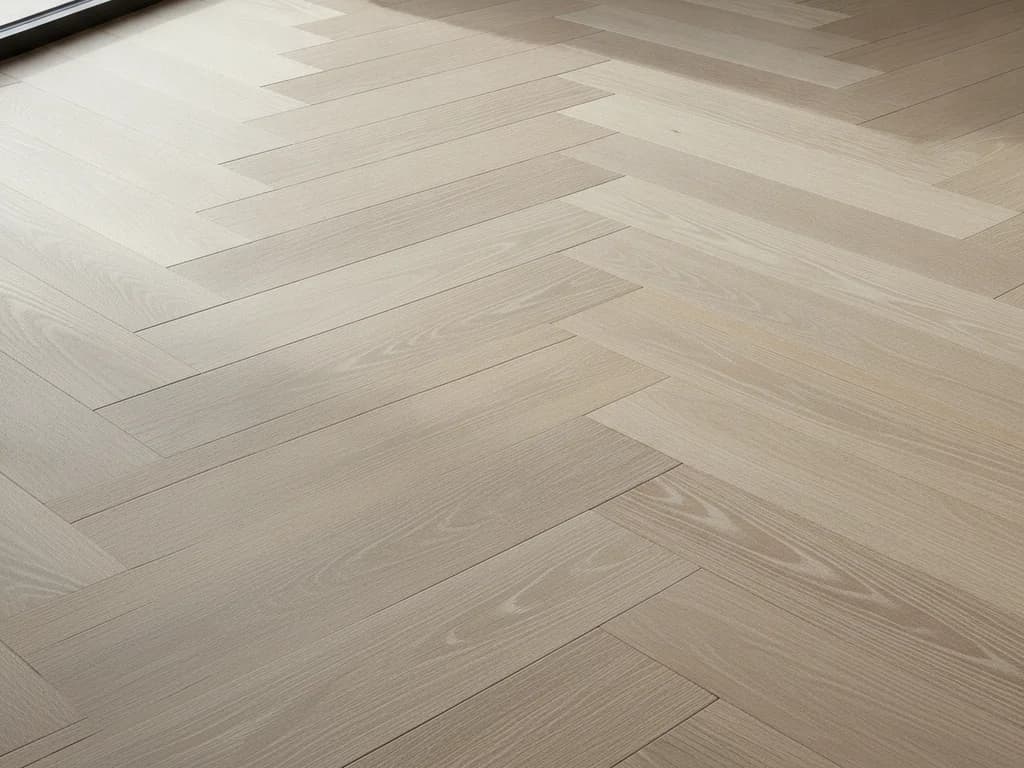
Look at the ends of the boards. Chevron boards are cut at an angle so they meet point to point, forming continuous unbroken V shapes that run the length of the room. Herringbone boards have square ends, so one board's end butts against the next board's side and the zigzag is staggered and broken rather than continuous.
That single milling difference produces everything else. Chevron requires each board to be cut at a precise angle at both ends, which means specialty milling, more waste, and a higher material cost — and it means left-hand and right-hand boards that must be kept in sequence. Herringbone uses ordinary square-cut rectangular boards, so the pattern is created entirely by how they are laid. Herringbone's complexity is in the installation; chevron's is in the material.
Visually, chevron is the more directional and the more formal of the two. The continuous V draws the eye down its axis and can make a room feel longer, and its clean geometry reads modern and French. Herringbone's broken zigzag is busier and more textural, reads more traditional and more classical, and does not impose a direction on the room in the same way. Both take dramatically longer to install than a straight-laid floor, and both are unforgiving of layout errors — an angle set wrong at the start compounds across the entire room.
Decision Framework
When Each One Wins
Conditions, not preferences. If one of these describes your project, it should carry more weight than anything else on this page.
Choose Chevron when…
- Formal, contemporary, and French-influenced interiors.
- Long rooms and hallways, where the continuous V reinforces the axis.
- Projects where a clean, precise, geometric floor is the design statement.
- Rooms where you want the floor to establish a strong direction.
Choose Herringbone when…
- Traditional and classical interiors — the historically older of the two patterns.
- Entries, studies, and dining rooms where you want texture rather than direction.
- Projects wanting pattern without the material premium of angled milling.
- Square rooms, where an imposed axis would fight the geometry.
- Combining with a plain border, which herringbone accepts naturally.
Side by Side
The Properties That Actually Differ
Where a figure is set by an individual product's instructions rather than by the material itself, the property is described as a relationship. An invented number would be worse than no number.
| Property | Chevron | Herringbone |
|---|---|---|
| Board ends | Cut at an angle so boards meet point to point. | Square-cut; one board's end meets the next board's side. |
| Resulting pattern | Continuous, unbroken V running the length of the room. | Staggered, broken zigzag. |
| Milling | Specialty angled cuts, in matched left- and right-hand boards. | Ordinary rectangular boards. |
| Material cost driver | Angled cutting wastes material and requires paired production. | Standard boards; no special milling. |
| Installation labor | High — angles must be exact and boards kept in sequence. | High — every board is individually placed and squared. |
| Effect on the room | Directional; emphasizes an axis and can lengthen a space. | Textural; adds richness without imposing direction. |
| Style association | Modern, formal, French. | Traditional, classical, European. |
| Borders | Usually framed with a border to contain the pattern. | Works framed or unframed. |
| Layout sensitivity | Very high — an error at the start propagates across the room. | Very high, for the same reason. |
It Depends
The Variables That Decide It
No comparison answers this for every house. These are the specific things about your project that move the answer, and they are worth establishing before you shop.
The shape of the room
Chevron announces a direction. In a long room that reinforces the proportion attractively; in a square room it can feel arbitrary. Herringbone is more neutral about room geometry and is the safer choice when the space has no obvious axis.
How the pattern meets the walls
Both patterns need a plan for the perimeter, where the diagonal runs into a straight wall. A border solves it and is traditional, but it consumes floor area and changes the proportion of the field. This should be designed before installation begins, not discovered during it.
Board size relative to the room
Pattern scale is a real design variable. Small boards in a large room produce a fine, busy texture; large boards in a small room produce very few complete repeats and can look cropped. The repeat needs to relate to the room's dimensions.
Whether the floor continues into adjacent rooms
A patterned floor usually wants a defined edge. Running chevron or herringbone through a doorway into a straight-laid hallway rarely resolves cleanly, so plan the transition — a border, a threshold, or a deliberate stop — as part of the design.
On this site: Chevron, Herringbone, Hardwood Flooring, and Cost Calculator.
Next decision: Wide Plank vs. Standard Width, American vs. European Oak, and Nail vs. Glue vs. Float.
See all 17 flooring comparisons, or look up a term in the glossary.
Common Questions
Frequently Asked Questions
Which is more expensive, chevron or herringbone?
Chevron material generally costs more, because angled milling produces waste and requires matched left- and right-hand boards. Installation labor is high for both — every board is individually placed and the layout must be exact. Our cost calculator holds the real installed ranges for this market rather than a general multiplier.
Is herringbone out of style?
It has been in continuous use for centuries, which is a reasonable defense against the question. It moves in and out of fashion like anything, but it is a historical pattern rather than a trend, and it reads as classical rather than dated in most interiors.
Can I install chevron or herringbone over concrete?
Yes, using engineered boards in the pattern, glued down over a properly prepared and moisture-tested slab. Glue-down is the usual method for patterned floors in any case, because the pattern needs every piece held exactly where it was placed.
Does a patterned floor make a room look smaller?
Not inherently, though scale matters. A pattern whose repeat is large relative to the room can look cramped, and a very fine repeat in a large room can look busy. Chevron's directionality can actively make a long room feel longer, which is one of the reasons it gets chosen.
Can herringbone be refinished?
Yes, if the wood is solid or has an adequate wear layer. It is more demanding work than a straight-laid floor: the grain runs in two directions across the pattern, so sanding must be managed to avoid cross-grain scratching. Expect a patterned floor to be a more specialized refinishing job.
Related
Keep Reading
Related pages: The Best Flooring for a Lake Tahoe Cabin, The Best Flooring for California Homes, Contact, and Flooring Comparisons.

Get a Straight Answer for Your House
Free estimates across Greater Sacramento & Northern California. We'll look at your subfloor and your rooms and tell you which of these actually fits — call (916) 749-0272.