Comparison
Wide Plank vs. Standard Width
Should I get wide-plank or standard-width flooring?
Should I get wide-plank or standard-width flooring?
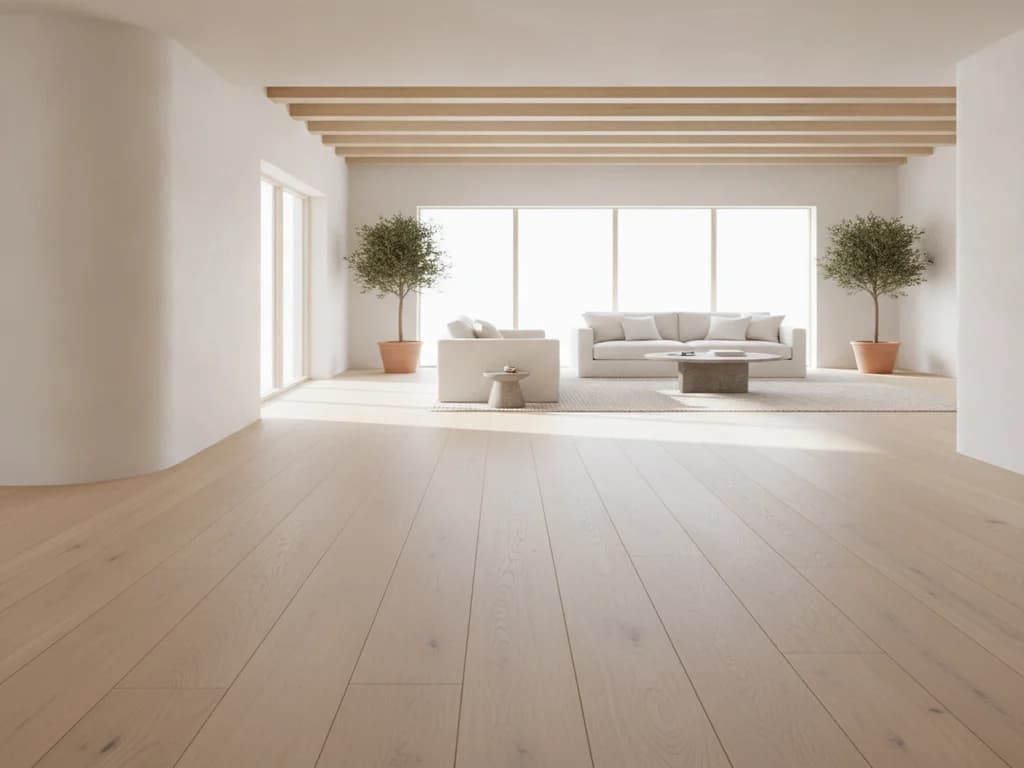
Wide plank makes a room look larger and calmer, because there are fewer seams to break up the floor. Standard-width strip flooring is more traditional, more forgiving, and better suited to smaller rooms and to period houses where wide boards would look wrong.
There is one piece of physics behind most of the technical difference. Wood expands and contracts as a percentage of its width, so a wider board moves further in absolute terms for the same change in humidity. A gap that is imperceptible between narrow strips becomes a visible line between wide planks. This is why premium wide plank is overwhelmingly sold as engineered — a cross-laminated core cancels most of that movement, which is exactly what a wide board needs.
The rest follows from format. Wide planks demand a flatter subfloor, because a long rigid board bridges high spots and rocks over them rather than following the surface. They are more often glued down than nailed, because full-area bonding restrains movement. They generate less installation labor per square foot but more waste at cuts, and they cost more per square foot as material because wide boards require larger, better logs. Standard strip flooring is the historic default for the opposite reasons: it is stable, forgiving, economical, and it looks correct in the houses that were built for it.
Decision Framework
When Each One Wins
Conditions, not preferences. If one of these describes your project, it should carry more weight than anything else on this page.
Choose Wide plank when…
- Large open-plan rooms, where wide boards read calm rather than busy.
- Contemporary, transitional, and mountain-modern interiors.
- Floors where you want the grain and character of each board to be visible.
- Engineered installations over slabs and radiant heat, where the format is well supported.
- Rooms where minimizing visible seams is the design goal.
Choose Standard width when…
- Period homes, where narrow strip flooring is the historically correct floor.
- Small rooms and hallways, where wide boards can look out of scale.
- Matching or extending existing strip floors.
- Solid nail-down installations, where narrower boards are more stable.
- Budget-conscious projects — narrower boards use smaller stock and cost less as material.
Side by Side
The Properties That Actually Differ
Where a figure is set by an individual product's instructions rather than by the material itself, the property is described as a relationship. An invented number would be worse than no number.
| Property | Wide plank | Standard width |
|---|---|---|
| Visual effect | Fewer seams; the room reads larger and calmer. | More seams; a busier, more traditional floor. |
| Seasonal movement | More absolute movement per board — gaps are more visible. | Less per board; movement distributes across many small joints. |
| Typical construction | Predominantly engineered, for stability. | Commonly solid, and widely available engineered. |
| Subfloor flatness demand | High — a long rigid board rocks over high spots. | Moderate — short narrow boards follow minor variation. |
| Usual installation method | Often glue-down, for full-area restraint. | Commonly nail-down. |
| Material cost driver | Wide boards require larger, higher-grade logs. | Smaller stock; more economical yield. |
| Waste | More material lost at cuts and around obstructions. | Less waste; offcuts are more reusable. |
| Room scale | Suits large rooms; can overwhelm small ones. | Suits any room, and is the safer choice in small ones. |
| Character visibility | Each board's grain, knots, and figure are on display. | Character is broken up across many narrow boards. |
It Depends
The Variables That Decide It
No comparison answers this for every house. These are the specific things about your project that move the answer, and they are worth establishing before you shop.
The size and proportion of the room
A wide plank in a small room reads as a few big boards rather than as a floor, and in a narrow hallway it can look like decking. Rooms have a scale, and the board width should relate to it. Lay out samples in the actual room rather than judging from a showroom floor.
The age and style of the house
A pre-war house with narrow strip flooring throughout has a coherence that a wide plank in one room breaks. This is not a rule against wide plank in old houses; it is a reason to think about the whole floor rather than the one room.
How flat the subfloor is right now
Wide plank raises the cost of an uneven subfloor, because the tolerance is tighter and correcting it takes real work. If the subfloor is known to be wavy, that is a cost attached to the wide-plank option specifically, and it belongs in the comparison.
How stable the indoor climate is
A house held at a steady humidity year-round makes wide plank's movement a non-issue. A house with big seasonal swings, or one left unconditioned for stretches, is where wide boards start showing gaps — and where an engineered construction stops being optional.
On this site: Wide-Plank Installation, Engineered Wood Flooring, and Cost Calculator.
Next decision: Chevron vs. Herringbone, Engineered vs. Solid Hardwood, and American vs. European Oak.
See all 17 flooring comparisons, or look up a term in the glossary.
Common Questions
Frequently Asked Questions
At what width does a floor count as wide plank?
There is no standards body that sets the line, and usage varies by region and by seller. Traditional American strip flooring is narrow, and anything meaningfully above that gets called plank. Rather than chasing a definition, compare actual widths side by side in the room — the visual difference between adjacent widths is what matters.
Do wide-plank floors gap more?
They show gaps more, because the same percentage change in width produces a larger absolute gap on a wider board. Engineered construction is the standard answer, since a cross-laminated core substantially reduces the movement in the first place.
Can solid hardwood be wide plank?
Yes, and it was historically — old houses have wide solid boards. It demands more of everything: acclimation, a stable indoor climate, careful fastening, and an owner who accepts visible seasonal gapping as part of the floor's character. Engineered removes most of that burden, which is why it dominates the modern wide-plank market.
Does wide plank cost more to install?
There are fewer boards to lay per square foot, but the flatness tolerance is tighter, subfloor preparation is more demanding, waste at cuts is higher, and glue-down adds adhesive and cure time. Our cost calculator carries the real installed ranges for this market rather than a general rule.
Is wide plank better for resale?
Current taste favors it, particularly in contemporary and open-plan houses, and it presents well. Taste in board width has swung before and will again. A floor that suits the house it is in will outlast the trend either way.
Related
Keep Reading
Related pages: Wide-Plank White Oak: The Heart of the Mountain-Modern Look, Contact, Flooring Comparisons, and European White Oak.
Get a Straight Answer for Your House
Free estimates across Greater Sacramento & Northern California. We'll look at your subfloor and your rooms and tell you which of these actually fits — call (916) 749-0272.