Comparison
American White Oak vs. European Oak
What is the difference between American white oak and European oak?
What is the difference between American white oak and European oak?
Format decides this far more often than species does. American white oak is the domestic standard and dominates solid strip and plank flooring. European oak dominates the premium prefinished engineered wide-plank market — long boards, wire-brushed textures, and multi-step European finishes. If what you want is an extra-wide prefinished plank in a specific designer color, you are almost certainly buying European oak, and the species question was settled by the product category before you started.
Botanically they are close relatives, not the same tree: American white oak is Quercus alba, while European oak is usually Quercus robur or Quercus petraea. All are white oaks in the trade sense — closed pores, tannin-rich, neutral base, receptive to reactive and fumed finishes. In hardness they sit in the same class; published figures for European oak vary by species and source, and no verified value is stated here, so treat hardness as effectively equivalent for flooring purposes rather than as a differentiator.
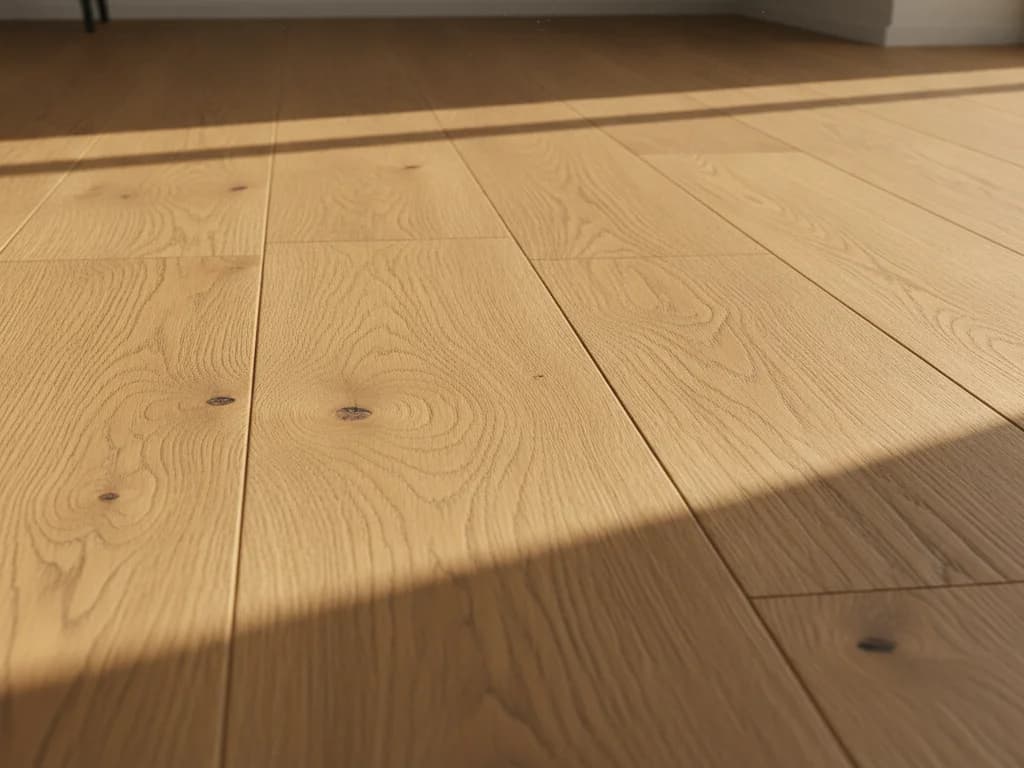
What does differ, reliably, is character. European oak typically reads busier — more knots, more mineral streaking, more color variation board to board, and grain that wanders. American white oak is more uniform and more tightly graded, so a floor of it looks calmer and more consistent. Both are attractive; they are simply different amounts of visual event on the floor.
Decision Framework
When Each One Wins
Conditions, not preferences. If one of these describes your project, it should carry more weight than anything else on this page.
Choose American white oak when…
- Solid nail-down floors, where it is the domestic standard.
- Site-finished work with a custom stain color.
- Matching or extending existing American oak floors.
- Rift and quartersawn cuts.
- Projects wanting a calm, uniform floor with limited board-to-board variation.
- Budget-conscious projects that still want genuine white oak.
Choose European oak when…
- Wide-plank and extra-long-board formats.
- Prefinished engineered floors in specific designer colors and textures.
- Wire-brushed, reactive, fumed, and hardwax-oil finishes.
- Character-grade looks with visible knots and mineral streaking.
- Chevron and herringbone, where European mills lead the market.
Side by Side
The Properties That Actually Differ
Where a figure is set by an individual product's instructions rather than by the material itself, the property is described as a relationship. An invented number would be worse than no number.
| Property | American white oak | European oak |
|---|---|---|
| Species | Quercus alba. | Usually Quercus robur or Quercus petraea. |
| Hardness | In the oak class — see our white oak vs. red oak comparison for the figure. | Same class. Published figures vary by species and source; no verified value is stated here. |
| Pore structure | Closed, tannin-rich. | Closed, tannin-rich. |
| Grain character | More uniform and consistent, tighter grading. | Busier — more knots, mineral streak, and color variation. |
| Typical format | Solid strip and plank; engineered available. | Predominantly engineered wide plank, often in long lengths. |
| Typical finish | Frequently site-finished to a custom color. | Usually prefinished with European multi-step, wire-brushed, or oil finishes. |
| Patterns | Available. | The market leader for chevron and herringbone. |
| Availability | Domestic and widely stocked. | Imported; selection is deep but lead times are longer. |
It Depends
The Variables That Decide It
No comparison answers this for every house. These are the specific things about your project that move the answer, and they are worth establishing before you shop.
The board width and length you want
If you want genuinely wide, genuinely long planks, the product market points to European engineered oak. That single requirement resolves the species question before any property comparison happens.
How much variation you want to look at
Character grade is a taste, not a defect. Some people want knots, streaks, and boards that differ; others find it restless and want the calm floor. Look at a full sample layout rather than one board — a single sample tells you nothing about how much a floor varies.
Prefinished or site-finished
European oak is bought overwhelmingly as a finished product, chosen from a catalog. American white oak is far more often finished on site to a color you developed. Which of those two processes you want is a real fork in the project, not a detail.
Lead time
Imported material is subject to availability and shipping in ways domestic stock is not. On a schedule-driven project this is a genuine constraint, and it is worth confirming before anyone falls in love with a sample.
On this site: European White Oak, French Oak, American White Oak, and Wide-Plank Installation.
Next decision: White Oak vs. Red Oak, Wide Plank vs. Standard Width, and Chevron vs. Herringbone.
See all 17 flooring comparisons, or look up a term in the glossary.
Common Questions
Frequently Asked Questions
Is European oak better quality than American white oak?
No. It is a different species selection and, more importantly, a different product market — European oak reaches the US mainly as premium prefinished engineered wide plank, so the products carry premium finishing and premium prices. That is a market fact about which products exist, not a statement that the wood is superior.
Is French oak the same as European oak?
French oak is European oak of French origin, generally the same species. The name signals sourcing and a grading and finishing tradition associated with the premium end of the market rather than a botanically distinct wood.
Which one takes a light, natural finish better?
Both do — that is what unites the white oaks and separates them from red oak. European oak is more often sold already finished that way, so the samples you see reflect it, but American white oak site-finished naturally achieves a comparable result with a calmer grain pattern.
Can I mix American and European oak in the same house?
In separate rooms with a transition, yes. In a continuous run, they will read as different floors — the grain character and grading differ enough to be visible even under the same color. Treat them as different materials when planning where floors meet.
Is European oak harder than American white oak?
Both are white oaks in the same hardness class, and the difference is not something you would notice in a floor. We do not state a Janka figure for European oak because published values vary by species and source and none was verified here. Choose on format, grain character, and finish, not on hardness.
Related
Keep Reading
Related pages: Laminate vs. Luxury Vinyl Plank: What's the Difference?, Tile vs. Luxury Vinyl for Bathrooms, Contact, and Flooring Comparisons.

Get a Straight Answer for Your House
Free estimates across Greater Sacramento & Northern California. We'll look at your subfloor and your rooms and tell you which of these actually fits — call (916) 749-0272.