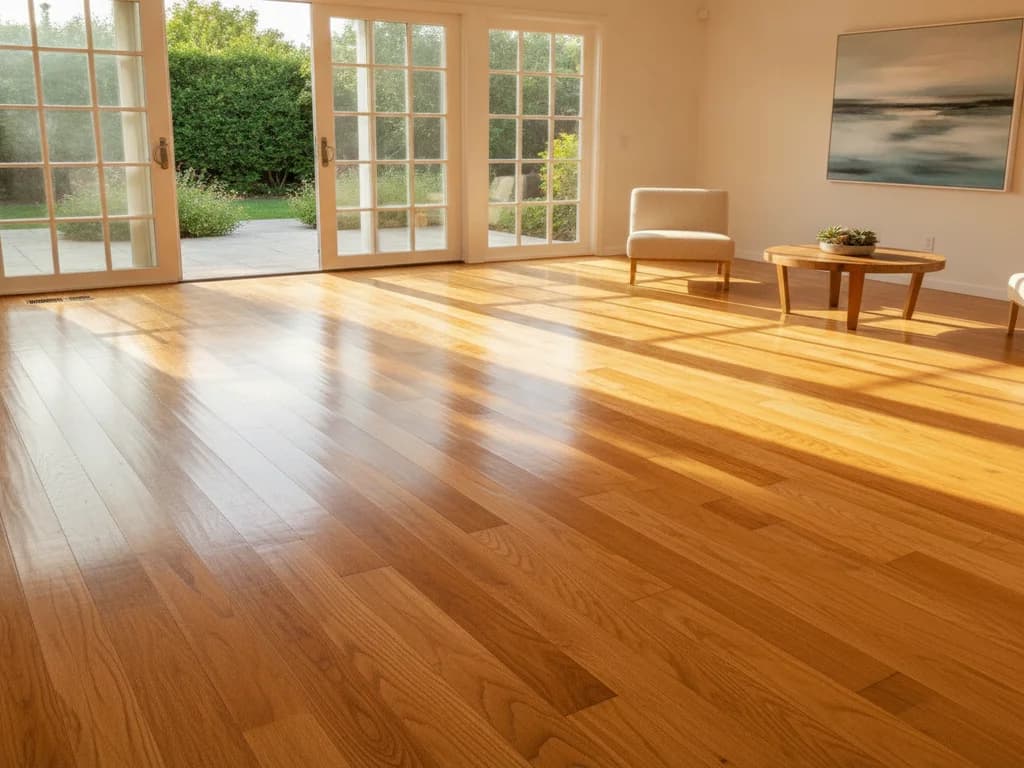
Comparison
Site-Finished vs. Prefinished Hardwood
Should I get site-finished or prefinished hardwood?
Should I get site-finished or prefinished hardwood?
Choose site-finished if you want a perfectly flat, seamless floor surface or a custom stain color that no factory sells. Choose prefinished if you want the house back sooner, cannot live with sanding dust and finish fumes, or want a factory-cured finish applied under conditions no job site can reproduce.
Site-finished means unfinished boards are installed first, then sanded flat as one plane and stained and coated in place. Because the sander levels the installed floor, adjacent boards end up truly flush and the seams disappear. Prefinished means each board arrives already sanded, stained, and coated, and the floor is complete the moment the last board is down. Factory finishes cure in controlled temperature and humidity, often with UV curing and abrasion-resistant additives that are not practical to apply on site.
The visible tell between them is the board edge. Prefinished boards carry a micro-bevel — a small chamfer at each edge, because factory-finished boards cannot be sanded flush after installation and the bevel disguises any height difference. Some people like the definition it gives each plank. Some want a floor that reads as one continuous surface. That preference, plus your tolerance for disruption, decides more of this than any technical argument.
Decision Framework
When Each One Wins
Conditions, not preferences. If one of these describes your project, it should carry more weight than anything else on this page.
Choose Site-finished when…
- You want a seamless surface with no bevel line between boards.
- You need a custom color, or a match to existing floors in the house.
- You are extending or blending into an existing site-finished floor.
- The floor includes stairs, borders, inlays, or transitions you want finished as one continuous piece.
- You are refinishing anyway, and adding new area to the same sanding.
Choose Prefinished when…
- You need the space usable quickly — the floor is done when installation is done.
- Anyone in the house is sensitive to dust or finish odor.
- You want the hardest available factory-cured surface with abrasion-resistant additives.
- You are installing engineered wide plank, which is overwhelmingly sold prefinished.
- You want to see the exact finished board before you commit, not a stain sample on a scrap.
Side by Side
The Properties That Actually Differ
Where a figure is set by an individual product's instructions rather than by the material itself, the property is described as a relationship. An invented number would be worse than no number.
| Property | Site-finished | Prefinished |
|---|---|---|
| Surface flatness | Sanded flat after installation — genuinely one plane across the room. | Each board finished individually; a micro-bevel absorbs any height variation at the seams. |
| Edge profile | Square, seamless, no visible joint line. | Micro-bevel or eased edge at every board. |
| Color options | Any color you can mix and sample on the actual wood. | The manufacturer's catalog. |
| Finish curing | Cures on site, at whatever temperature and humidity the house is at. | Cured in factory-controlled conditions, often UV-cured. |
| Timeline | Longer — sanding, staining, and multiple coats with dry time between each. | Shorter — the floor is complete when the last board is fastened. |
| Disruption | Sanding dust and finish odor; the space is off-limits during coats and cure. | Installation dust only. |
| Future refinishing | Straightforward. The floor was site-finished once and can be again. | Also refinishable, but the first sanding removes the factory finish and the micro-bevels. |
| Spot repair | A repaired area can be blended into the surrounding finish. | A damaged board is usually swapped for an identical one from the same run. |
It Depends
The Variables That Decide It
No comparison answers this for every house. These are the specific things about your project that move the answer, and they are worth establishing before you shop.
Whether anyone can move out
Site finishing is not compatible with occupying the room. Between sanding, staining, and coats there is a stretch where the floor cannot be walked on and the air is not pleasant. If the household cannot relocate, the calculation is largely made.
Whether you love or hate the bevel
This is an aesthetic question posing as a technical one. Look at both in person under raking light. The bevel is a permanent, visible feature of the floor, not a detail you stop noticing.
Whether the color exists
If a catalog color genuinely satisfies you, most of site finishing's advantage evaporates. If you are chasing a specific tone — matching millwork, matching an adjacent room, hitting a particular undertone on a particular species — only site finishing can be iterated until it is right.
The species
Some species take stain evenly and some do not. Maple's tight, closed grain is notoriously prone to blotching, which makes a factory-finished maple product a much safer bet than a job-site stain attempt on it.
On this site: Hardwood Flooring, Floor Refinishing, and Flooring Glossary.
Next decision: Water-Based vs. Oil-Based Poly, Engineered vs. Solid Hardwood, Screen-and-Recoat vs. Full Refinish, and Oak vs. Hickory vs. Maple.
See all 17 flooring comparisons, or look up a term in the glossary.
Common Questions
Frequently Asked Questions
Is prefinished hardwood more durable than site-finished?
The factory finish is typically harder, because factory conditions allow curing methods and abrasion-resistant additives that are impractical on a job site. That is a real advantage at the board surface. It is partly offset by the bevels, which create small grooves that collect grit and are harder to clean than a flat surface.
How long does site finishing take?
Longer than installation alone, because each stage has to dry before the next: sand, stain if you are staining, then multiple coats of finish. The floor is usually walkable well before it is fully cured, and full cure runs longer than most people expect. The finish manufacturer's schedule governs both — follow it rather than a general rule of thumb.
Can you site-finish an engineered floor?
Yes, if the product is sold unfinished and the wear layer is thick enough to survive a sanding. Most engineered flooring is sold prefinished, so this is a narrower option than it is with solid, and it needs to be confirmed against the specific product rather than assumed.
Can I mix prefinished and site-finished floors in the same house?
In separate rooms, easily, with a transition at the doorway. Within a single continuous run it does not work — the bevels stop and start, and the sheen and color will not match across the change. Where two floors meet in an open plan, plan the transition rather than hoping the eye skips it.
Do prefinished floors have shorter warranties?
Warranty terms come from the individual manufacturer and vary widely, so there is no general answer. What is structurally true is that a prefinished floor comes with a finish warranty from the finish's maker, while a site-finished floor's surface is warranted by whoever applied it. Read the actual document either way.
Get a Straight Answer for Your House
Free estimates across Greater Sacramento & Northern California. We'll look at your subfloor and your rooms and tell you which of these actually fits — call (916) 749-0272.