Comparison
Oak vs. Hickory vs. Maple
Which is the best hardwood species — oak, hickory, or maple?
Which is the best hardwood species — oak, hickory, or maple?
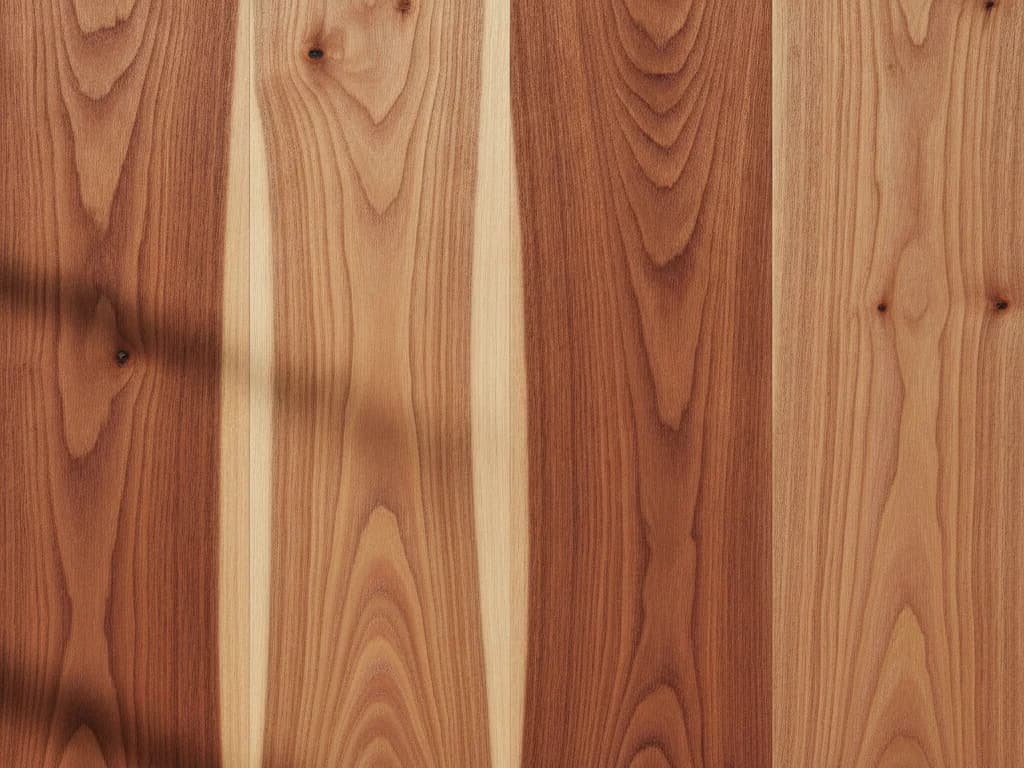
Oak is the default for good reasons: it stains predictably, its grain hides wear, and everyone can source it. Hickory is the hardest of the three and hides damage best, at the cost of dramatic color variation not everyone wants. Maple is harder than oak but the least forgiving of the three — its fine, closed grain shows dents and scratches more clearly and stains unevenly.
The Janka numbers invite the wrong conclusion. Hard maple measures around 1,450 lbf and hickory around 1,820, both above oak's roughly 1,290 to 1,360 — and yet maple, the middle number, is the species that most visibly shows damage. Hardness measures resistance to denting. It says nothing about whether a dent is *visible*, and visibility is governed by grain and color variation, not by force. Hickory's wild figure camouflages everything; oak's cathedral grain camouflages a lot; maple's uniform, near-blank surface camouflages nothing.
That is the practical hierarchy for a busy household: hickory hides the most, oak hides plenty and behaves predictably under stain, and maple is the species to choose for its clean, contemporary look rather than for toughness — best under a natural or lightly toned finish, in rooms that are not taking the worst of the traffic.
Decision Framework
When Each One Wins
Conditions, not preferences. If one of these describes your project, it should carry more weight than anything else on this page.
Choose Oak when…
- Almost any project — it is the default because it is genuinely versatile.
- Any custom stain color; oak takes stain evenly and predictably.
- Floors you expect to refinish repeatedly over decades.
- Matching existing floors, since most American wood floors are oak.
- Wide plank, rift and quartersawn, chevron, and herringbone — all well supplied.
Choose Hickory when…
- Households with large dogs, heavy traffic, or hard use.
- Rustic, ranch, cabin, and mountain interiors where dramatic variation is the aesthetic.
- Floors where hiding future wear matters more than a uniform appearance.
- Rentals and vacation properties that see rough, intermittent use.
Choose Maple when…
- Clean, contemporary, light interiors wanting minimal grain.
- Natural or lightly toned finishes rather than deep stains.
- Rooms with moderate traffic — bedrooms, formal living spaces, studios.
- The pale, uniform Scandinavian look, which oak and hickory cannot produce.
Side by Side
The Properties That Actually Differ
Where a figure is set by an individual product's instructions rather than by the material itself, the property is described as a relationship. An invented number would be worse than no number.
| Property | Oak | Hickory | Maple |
|---|---|---|---|
| Janka hardness | About 1,290–1,360 lbf depending on red or white. | Around 1,820 lbf; a group figure across hickory species. | About 1,450 lbf for hard (sugar) maple. |
| Grain | Pronounced cathedral figure; the familiar wood-floor look. | Bold and irregular, with knots and strong contrast. | Fine, tight, and nearly featureless. |
| Color variation | Moderate. | Extreme — pale sapwood beside dark heartwood in the same floor. | Minimal; pale and consistent. |
| Hides wear and scratches | Well. | Best of the three. | Poorly — damage is highly visible on a uniform surface. |
| Stain behavior | Predictable and even; takes almost any color. | Uneven across the color variation; stain fights the natural contrast. | Prone to blotching; needs a conditioner or a professional multi-step process. |
| Best finish approach | Anything — natural, stained, wire-brushed, reactive. | Natural or light; the wood already provides the drama. | Natural or lightly toned; deep stains are a specialist job. |
| Working and sanding | Straightforward. | Hard on tooling; harder to sand flat. | Dense and unforgiving; sanding marks show readily. |
| Availability | Excellent in every format. | Good, mostly in rustic and character grades. | Good, but fewer wide-plank and pattern options. |
It Depends
The Variables That Decide It
No comparison answers this for every house. These are the specific things about your project that move the answer, and they are worth establishing before you shop.
Whether you want to stain it
This eliminates species faster than anything else. If a specific custom color is the goal, oak is the species that gets there reliably. Maple resists even coloring, and hickory's own contrast fights whatever you put on it.
How much visual activity you want
These three occupy opposite ends of a spectrum: hickory is loud, oak is moderate, maple is quiet. It is worth seeing a large sample layout of each rather than single boards, because the differences compound enormously across a room.
What the floor will actually endure
Hardness matters where things are dropped and dragged. Visibility of damage matters everywhere else, and it is usually the property people actually care about. Ask which one your household is optimizing for, because the answers point to different species.
Who is doing the finishing
Maple in particular rewards experience — blotch control and even sanding on a dense, pale, closed-grain wood is not beginner work. If the finish is being applied on site, the species raises or lowers the difficulty of the job substantially.
On this site: Hickory, Maple, Hardwood Flooring, and Flooring Glossary.
Next decision: White Oak vs. Red Oak, American vs. European Oak, and Site-Finished vs. Prefinished.
See all 17 flooring comparisons, or look up a term in the glossary.
Common Questions
Frequently Asked Questions
Is hickory too busy for a modern house?
It can be, and it is worth being honest with yourself about it. Hickory's pale-to-dark contrast is a strong design statement that suits rustic and mountain interiors and can overwhelm a minimal one. Tighter grade selections reduce the variation but do not eliminate it — the variation is the wood.
Why does maple dent if it is harder than oak?
It dents less, but shows dents more. Janka measures the force to embed a steel ball, which is resistance to denting; whether the resulting mark is visible depends on grain and color. Maple's uniform pale surface gives a dent nowhere to hide, while oak's figure breaks up the eye's ability to see it.
Which of the three is best with dogs?
Hickory, on both counts — it is the hardest of the three and its grain hides the marks that do occur. Oak is a solid second. Maple is the one to think twice about with active dogs, since claw marks on a pale, featureless floor are conspicuous.
Can all three be refinished?
Yes, if they are solid or engineered with an adequate wear layer. Hickory and maple are both harder to sand well — hickory because of density and figure, maple because sanding marks show on a uniform surface — so refinishing them is more demanding work than refinishing oak.
Is there a hardwood harder than hickory?
Several imported species measure higher on the Janka scale. Hickory is the hardest of the widely available North American flooring species, which is what makes it the practical ceiling for most projects. Beyond a point, added hardness stops improving how a floor looks over time, because appearance is governed by grain rather than by force resistance.
Related
Keep Reading
Related pages: Flooring for South Lake Tahoe & Meyers Homes, Choosing Flooring for a Tahoe Vacation Rental, Contact, and Flooring Comparisons.
Get a Straight Answer for Your House
Free estimates across Greater Sacramento & Northern California. We'll look at your subfloor and your rooms and tell you which of these actually fits — call (916) 749-0272.