Cost & Value
How Much Does Carpet Installation Cost?
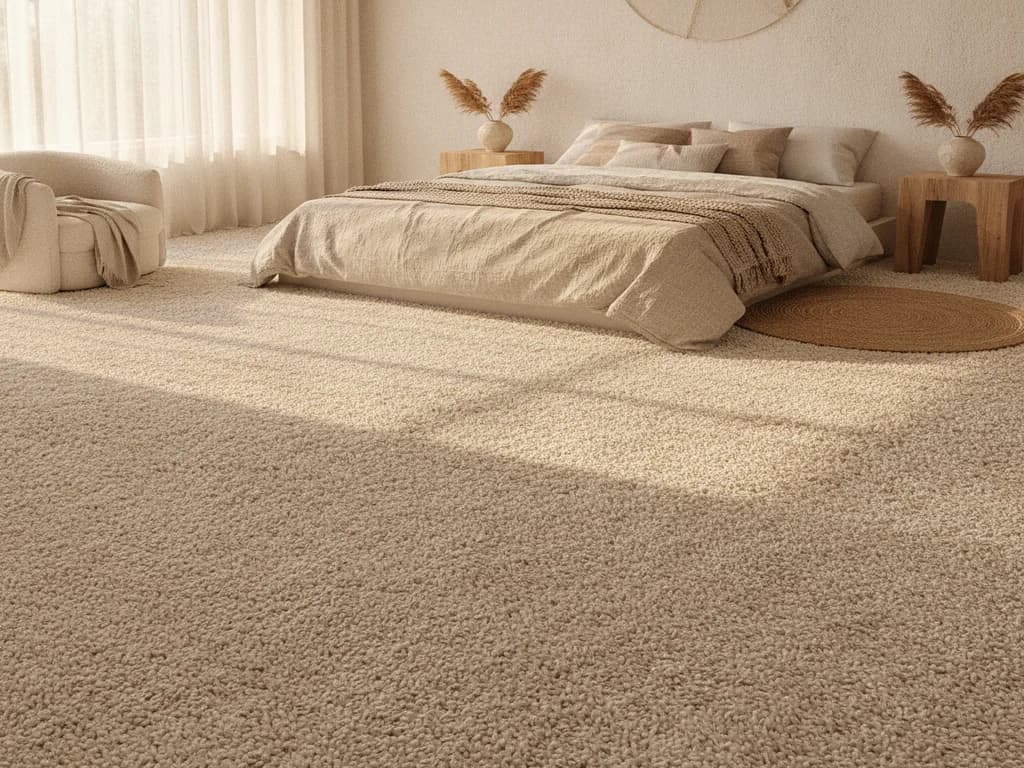
Carpet is one of the lowest installed costs in flooring, but the pad, the stretch, the stairs, and what comes up first all move the number. Here's what sits behind a carpet quote.
Cost & Value · 10 min read
Published November 12, 2026 · Updated November 13, 2026
For planning purposes, carpet in our market typically runs about $4–9 per square foot installed, and removing what is there now usually adds roughly $1–3 per square foot. Those are planning ranges, not quotes. Our cost calculator will turn them into a number for your rooms, and our cost guide shows how carpet sits against every other floor we install. This article explains what moves a carpet job from one end of that range to the other, and why two quotes for the same bedrooms can be far apart without either installer being dishonest.
Most of what separates a carpet floor that stays tight and flat from one that ripples within a couple of years is invisible on installation day: the cushion under it, how hard it was stretched, what holds the edges, and where the seams were put.
What a Carpet Installation Actually Includes
A stretch-in carpet floor is a system, not a roll of fabric. Tack strip is nailed, stapled, or glued around the perimeter of each room, a separate cushion is laid and fastened inside it, the carpet is cut to a seaming diagram, seamed, stretched tight across the room, and hooked onto the pins of the tack strip. Transitions are fitted where the carpet meets another floor.
The industry's reference for doing this is CRI 105, the Carpet and Rug Institute's standard for residential carpet installation; its commercial counterpart is CRI 104. CRI describes them as the only carpet installation standards created and supported by the industry. Most of the cost drivers below trace back to something CRI 105 requires, and the most useful thing you can do when comparing quotes is ask whether each installer works to it.
CRI 105 says correct measurements and a detailed diagram are essential before an installation can be professionally estimated, which is why a carpet number from square footage alone is a placeholder.
Cushion Is the Line Most Quotes Hide
The pad is the least visible part of the job and one of the most consequential. CRI's homeowner guidance calls the cushion the foundation for the carpet and says the wrong cushion can cause diminished appearance, wrinkling, buckling, separated seams, and breakdown of the carpet structure, and that improper cushion selection may void the carpet manufacturer's warranty.
CRI's rule of thumb for most residential carpet is cushion no more than 7/16 inch thick and no less than 1/4 inch, at 6 pounds per cubic foot density. For berber or other low-profile carpet, the guidance drops to no more than 3/8 inch thick at 8 pounds density, because large loops need a stable, low-flexing base and a thicker, softer pad is not recommended. CRI 105 itself caps residential cushion thickness at 7/16 inch and requires the cushion to conform to the carpet manufacturer's recommendations for that specific product.
The counterintuitive part is that thicker and softer is not an upgrade everywhere. CRI says bedrooms and other light-traffic rooms can take a thicker, softer cushion, while living rooms, hallways, stairs, and other heavy-traffic areas need a thinner, firmer one. Two quotes can carry very different pads under the same carpet, and the cheaper one is not always the one with the thinner pad. Ask what cushion is included, by type, thickness, and density, and whether it matches the carpet manufacturer's requirement.
Fiber and Construction Drive the Material Number
CRI notes that most carpet made in the United States uses one of five primary pile fibers: nylon, polyester, polypropylene (olefin), triexta, and wool. Each offers different durability, abrasion resistance, texture retention, stain and soil resistance, colorfastness, and ease of cleaning, and that is where much of the material price difference lives.
Construction matters as much as fiber. CRI describes cut pile as getting its durability from fiber type, tuft density, and the amount of twist in the yarn, with highly twisted yarn holding its shape longer in traffic. Textured plush and frieze hide footprints, velvet plush shows marks easily and suits low-traffic rooms, and level loop holds up well in traffic. A dense, tightly twisted cut pile and a loose one can look similar on a sample board and wear very differently in a hallway.
Pattern adds labor on top of material. CRI 105 notes carpet is subject to bow, skew, and other pattern variations, that there are no industry standards for pattern variation, and that patterned carpet may require additional stretch to hold the pattern match. Matching a pattern across a seam also consumes extra material, because the layout has to allow for the repeat.
Power Stretching, Tack Strip, and Room Size
The single most important step in a stretch-in installation is the stretch itself. CRI 105 makes the use of a power stretcher mandatory, lays out a seven-step stretching sequence, and says that absent manufacturer instructions, tufted carpet with synthetic backing should be stretched a minimum of 1% in both length and width. CRI's homeowner checklist puts the reason plainly: power stretching is required to minimize wrinkling and rippling.
This is the most common gap between a careful quote and a fast one, because under-stretched carpet looks fine on day one. It shows up later as carpet ripples, and the fix is a professional restretch.
Room size changes the hardware. CRI 105 requires tack strip at least 1 inch wide and 1/4 inch thick, fastened with at least two fasteners per piece, and for stretching areas longer than 30 feet it requires wider architectural strip or a doubled row of standard strip to hold the extra tension. On radiant-heated floors, tack strip has to be secured with an approved adhesive rather than nails or screws to avoid damaging the heating system. A long great room or a floor over radiant heat is a different job from a standard bedroom.
Seams, Layout, and Waste
Where a room needs a seam, where it goes is a cost decision and an appearance decision at the same time. CRI 105 says to keep seams to a minimum and, where possible, to run them the length of the area, parallel to main traffic, away from pivoting traffic, not perpendicular to doorways, and where natural light does not strike across them. CRI also tells homeowners not to expect seams to be invisible.
Good seam placement sometimes costs material. CRI 105 requires the carpet to be cut to the seaming diagram with at least 3 inches allowed along each wall for trimming, plus enough to match patterns. A layout that puts the seam in the right place may use more carpet than one that minimizes square yardage, and an installer quoting the cheapest yardage may be choosing a worse seam.
Every seam also has to be sealed. CRI 105 says all seams must be sealed unless the manufacturer specifies otherwise, and the homeowner checklist explains why: sealing seam edges prevents delamination and edge ravel. Where carpet meets another floor without a transition molding, CRI 105 requires a bead of seam sealer along the entire edge; otherwise, carpet edges are to be covered with transition moldings.
Stairs Are Their Own Job
Stairs are priced separately from open floor because every step is cut, fitted, and fastened individually. CRI 105 requires the treads, risers, and nosing to be clean, dry, and structurally sound, with the nose return rounded so sharp edges do not cut the carpet or cushion, and the cushion extended over the nose.
The installation style changes the labor. CRI 105 describes a waterfall installation, where tack strip goes on each tread and on the risers and the carpet flows over the nose, and a cap-and-band or contoured technique, where tack strip is not used on the riser and the carpet is wrapped tight to the shape of the stair. Upholstered work like cap-and-band requires every exposed edge to be sealed and no raw edges showing, which is slower per step. Most manufacturers, CRI notes, recommend the pile run down the stairs.
If you want a runner rather than wall-to-wall carpet on the stairs, that is a separate scope; our stair runners and treads page covers it.
What Comes Up First, and Where It Goes
Removal is usually priced on its own, roughly $1–3 per square foot as a planning range, and the low end is typical for old carpet and pad. Tack strip, staples, and glued pad take longer, and old resilient flooring under the carpet is a different conversation entirely.
CRI 105 says carpet should not be installed over existing carpet unless the manufacturer specifically allows it. Carpet over existing resilient flooring may be acceptable if it is securely bonded and clean, but CRI 105 does not recommend going over floating, perimeter-bonded, or cushion-backed sheet goods. It also warns that some older sheet vinyl, resilient tile, and cutback adhesive may contain asbestos, prohibits sanding, dry scraping, or mechanically pulverizing those materials, and says removal must follow federal, state, and local rules for asbestos-containing materials. If old vinyl turns up under your carpet, removal can become a separate, regulated step rather than a line on a flooring quote.
Disposal has a California angle. CalRecycle runs the state's Carpet Stewardship Program, operated by Carpet America Recovery Effort (CARE), the nonprofit stewardship organization created by carpet manufacturers, so that postconsumer carpet is reused, recycled, or properly disposed. Under the Public Resources Code, retailers and wholesalers add a carpet stewardship assessment to the price of carpet sold in the state, shown as a separate line item on the invoice. If you see a line labelled something like "CA Carpet Stewardship Assessment," it is that state-required charge, not an installer fee.
Furniture, Prep, and the Day Itself
CRI's installation checklist tells homeowners to settle, before the day, who moves the furniture and whether the installer charges an additional moving fee, and who removes and disposes of the old carpet and cushion. It also recommends finishing painting before the carpet goes in and removing breakables; our guide to preparing your home for a flooring installation walks through the rest.
CRI 105 also sets room conditions: the HVAC system should be running, with indoor temperature between 65 and 95 degrees Fahrenheit and relative humidity no higher than 65%, for at least 48 hours before, during, and 72 hours after the installation. In a Sacramento-area summer or a cold foothill winter, that can affect scheduling.
Concrete, Moisture, and Glue-Down
Over a concrete slab, the installation method decides how much testing is involved. CRI 105 states that most residential stretch-in installations do not require moisture testing. For direct glue-down, double glue-down, and floating carpet tile systems, though, both CRI 105 and the commercial CRI 104 standard require a written report on the moisture and alkalinity conditions of the concrete before work begins, using the industry test methods, and they recommend independent third-party testing.
Glue-down is a different installation entirely. CRI 104 defines direct glue-down as carpet adhered straight to the substrate with the proper adhesive, and double glue-down as cushion adhered to the floor and carpet then adhered to the cushion. Both add adhesive, trowel work, and moisture testing to the job, so a glue-down quote is not comparable to a stretch-in one. If you are fighting dampness under an existing floor, our page on moisture under flooring is a better starting point than a carpet quote.
Low-Emitting Carpet and California Code
CRI's Green Label Plus program tests carpet, cushion, and adhesive for volatile organic compound emissions, with testing handled by an independent laboratory. The California Department of Public Health lists Green Label Plus among the certification programs whose initial test is compliant with CDPH Standard Method v1.2, the state's emissions test for indoor building products.
California's green building code, CALGreen, has a residential section on carpet systems, 4.504.3, with a subsection for carpet cushion. In the 2019 code cycle, the state amended that section to reference the CDPH standard for carpet system emissions and removed the older Green Label reference for cushion. Whether CALGreen formally governs your project depends on the scope of work, but asking for certified carpet, cushion, and adhesive is a simple way to filter for low-emitting products either way.
Why Carpet Quotes Differ
Put together, the gap between two carpet quotes for the same rooms usually comes from a short list: the cushion included, whether the carpet is power-stretched, how seams are placed, whether stairs are waterfall or cap-and-band, whether removal, disposal, furniture moving, and transitions are inside the number, and what the subfloor needs. None of these is visible once the carpet is down, and all of them decide whether it stays flat.
If you are still deciding between carpet and a hard floor, our comparisons of carpet vs. LVP and carpet vs. hard surface in bedrooms lay out the tradeoffs, and our carpet installation page covers what we install.
Getting an Accurate Number
The only way to get a carpet number you can rely on is a walkthrough: measuring each room, looking at the stairs, checking what is under the existing floor, and agreeing on where the seams go.
If you'd like an honest, no-pressure estimate for carpet installation in your home, Renaissance Floors serves Roseville and the Greater Sacramento & Northern California area. Call (916) 749-0272 or request a free estimate — we'll give you a real number based on what's actually in your home.
This article is part of our guide to what flooring actually costs, which covers how flooring is priced, what moves the number, and where the money goes that nobody quotes for.
Sources
- CRI 105 Standard for Installation of Residential Carpet (Carpet and Rug Institute)
- CRI 104 Standard for Installation of Commercial Carpet (Carpet and Rug Institute)
- CRI Installation Standards overview
- CRI: Selecting the Right Carpet
- CRI: Installation Tips (homeowner checklist)
- CRI Green Label Plus program
- CDPH: List of Certifications and Programs that Use CDPH Standard Method v1.2 (2017)
- California Building Standards Commission: HCD 08/19 Commission Action Matrix, CALGreen Part 11
- CalRecycle: Carpet Materials Management
- CalRecycle: Approved Labels and Descriptions for Carpet Invoices
Explore related
Good to Know
Frequently Asked Questions
How much does carpet installation cost per square foot?
In the Greater Sacramento and Northern California market, carpet typically plans at about $4–9 per square foot installed, with removal of the existing floor adding roughly $1–3 per square foot. The cushion, carpet fiber and construction, stairs, and subfloor condition decide where a specific job lands.
What carpet pad thickness should I use?
The Carpet and Rug Institute's rule of thumb for most residential carpet is cushion no more than 7/16 inch thick and no less than 1/4 inch at 6 pounds per cubic foot density. For berber or low-profile carpet, it recommends no more than 3/8 inch at 8 pounds. The carpet manufacturer's own requirement takes priority.
Is a thicker carpet pad always better?
No. The Carpet and Rug Institute says light-traffic rooms like bedrooms can use thicker, softer cushion, while living rooms, hallways, stairs, and other heavy-traffic areas need thinner, firmer cushion. Too soft a pad under the wrong carpet can cause wrinkling, buckling, and seam separation.
Why does my new carpet have ripples?
The most common cause is carpet that was not stretched tightly enough. The CRI 105 residential installation standard makes a power stretcher mandatory and calls for tufted carpet to be stretched at least 1% in each direction unless the manufacturer says otherwise. Rippled carpet can usually be professionally restretched.
Why is carpet on stairs priced separately?
Each step is cut, fitted, and fastened individually, so stairs take far more labor per square foot than an open room. A waterfall installation uses tack strip on treads and risers, while cap-and-band or contoured work wraps the carpet to the stair's shape with sealed edges, which is slower per step.
Can new carpet be installed over old carpet?
Generally not. The CRI 105 residential installation standard says carpet should not be installed over existing carpet unless the carpet manufacturer specifically recommends it. Old carpet, pad, and usually tack strip come up first, which is why removal is normally a separate line on a carpet quote.
Does carpet installation over concrete require moisture testing?
For typical stretch-in carpet, usually not; the CRI 105 standard says most residential stretch-in installations do not require moisture testing. Glue-down, double glue-down, and floating carpet tile systems are different: the CRI standards require a written report on the concrete's moisture and alkalinity conditions before installation.
What is the California carpet stewardship assessment on my invoice?
California law requires carpet retailers and wholesalers to add a carpet stewardship assessment to the price of carpet sold in the state and show it as a separate line item. It funds the state's Carpet Stewardship Program, which CalRecycle oversees and the Carpet America Recovery Effort runs. It is not an installer fee.
Does the installer move furniture?
It depends on the company, and it is one of the most common differences between quotes. The Carpet and Rug Institute recommends confirming before installation day who moves the furniture, whether there is an additional moving fee, and who removes and disposes of the old carpet and cushion.
What does Green Label Plus mean on carpet?
Green Label Plus is the Carpet and Rug Institute's voluntary program that tests carpet, cushion, and adhesive for volatile organic compound emissions through an independent laboratory. The California Department of Public Health lists its initial test as compliant with CDPH Standard Method v1.2, the state's emissions test for indoor products.
Ready to price it for your house?
See how we install carpet installation or skip ahead: a free in-home estimate means Alex measures the rooms, checks the subfloor, and quotes the exact product — no planning ranges.
Written by
Owner & Lead Installer, Renaissance Floors
15+ years of hands-on flooring experience across Greater Sacramento & Northern California. Works on hardwood and engineered installation, refinishing, subfloor preparation, and moisture testing — and writes these guides from what the jobs actually teach.
Licensed California contractor, CSLB C-15 license #1060673(verify ↗)

Related
Keep Reading
Related pages: Vinyl Plank Separating, Water Damage, American Walnut, and Wide-Plank Flooring.

Ready for Floors You'll Love?
Ready to talk through your project? Free estimates throughout Greater Sacramento & Northern California.