Cost & Value
How Much Does Tile Flooring Cost to Install?
Tile quotes swing on what sits under the tile: floor stiffness, slab cracks, flatness, membranes, and mortar. Here's what moves the number, with the standards behind each line.
Cost & Value · 9 min read
Published November 12, 2026 · Updated November 13, 2026
For planning, installed tile in our Northern California market runs about $10–$20 per square foot, and tearing out the old floor is a separate line of roughly $1–$3 per square foot. Our cost calculator runs those ranges against your square footage, and the cost guide sets them beside the other floor types we install. This article covers why the tile range is so wide, and why two honest quotes for the same room can land far apart.
The short version is that a tile floor is a system, and most of the cost differences sit in the layers you never see once the grout is in. The tile can be the same. What changes from one house to the next is the floor it goes onto.
What a Tile Price Actually Covers
A finished tile floor has several parts: the structure (joists and subfloor, or a concrete slab), whatever is done to make that structure flat and stable, any membrane between the substrate and the tile, the mortar, the tile, the grout, and the movement joints that let the assembly expand and contract. Each part is covered by a published standard. The Tile Council of North America (TCNA) maintains the industry handbook of installation methods, and the American National Standards Institute (ANSI) publishes the material and workmanship specifications behind them, including A137.1 for ceramic tile, A108.02 for general workmanship, and the A118 series for mortars and membranes.
That is why a bid with only a material line and a labor line is hard to compare against one that lists prep, membrane, and movement joints separately. The second contractor is not padding the bid. Those items are just written down.
Floor Stiffness on Wood-Framed Floors
On a raised wood floor, the first question is how much the floor bends under load. TCNA's traditional minimum for a floor that will be tiled is L/360, measured before the tile underlayment goes down, meaning the floor should not deflect more than the joist span divided by 360. On a 10-foot span, that works out to no more than a third of an inch between the center and the end.
There are two complications. First, TCNA notes that floors can meet L/360 across the joists and still bend too much between joists, giving 24-inch joist spacing as the example. Second, TCNA says its recommendations are based on installation methods proven to work over normal code construction, not on a single deflection reading. In practice that means the subfloor and underlayment build-up matters as much as the joists.
Natural stone is stricter. The Ceramic Tile Education Foundation, summarizing the TCNA Handbook, gives L/720 as the maximum allowable deflection for a stone floor on wood framing, twice as stiff as ceramic. It also says two layers of structural wood panel are required under stone when backer board is the substrate. If you want a stone floor over a crawlspace, the quote may include extra subfloor work that a porcelain floor in the same room would not need. Our natural stone flooring page covers where stone makes sense.
Excessive deflection is not just a theory. TCNA lists it among the causes of tile losing its bond, along with delaminated or moisture-damaged subfloor, and notes that floor failure is more likely over wood than over concrete once bond is lost. That is the mechanism behind many tile cracks and hollow spots.
Slab Cracks and Crack-Isolation Membranes
Many homes in our area sit on concrete slabs. TCNA explains that when tile is bonded directly to concrete, cracks in the slab tend to show up in the tile above them, which is called reflective cracking. TCNA also notes that even small shrinkage cracks can stay active as the slab keeps curing.
TCNA describes two ways to prevent it. One is a mortar bed over a cleavage membrane, a slip sheet that keeps the bed from bonding to the slab so the tile floats over it. The other is a crack-isolation membrane, bonded to the concrete with tile set on top. These membranes are covered by ANSI A118.12, and TCNA explains that they stretch where needed so movement in the concrete is not passed into the tile. They come trowel-applied or as sheets, and many systems have more than one step.
How much membrane goes into the quote depends on the slab. TCNA notes that membranes are sold for everything from isolating individual shrinkage cracks to covering the whole floor. Treating a few cracks is a smaller line than covering a whole kitchen. You can't tell which a slab needs until the old floor is up.
Waterproofing and Uncoupling Membranes
Waterproofing is a separate job with its own standard. ANSI A118.10 covers load-bearing, bonded, waterproof membranes for thin-set tile and stone, while A118.12 covers crack-isolation membranes. A product meeting one is not automatically doing the other's job, so check which standard a membrane on your quote is meant to meet. Whether a bathroom or laundry floor gets a waterproofing layer, and how far it runs, changes the materials and labor on the quote.
The bigger point is that a membrane does not replace movement joints. TCNA says it plainly: it is a common misconception that anti-fracture membranes let you eliminate expansion joints, and soft joints are always required in the tile work.
Flatness, Lippage, and Large-Format Tile
Flatness is where most of the cost differences between tile jobs come from, and large tile makes it more demanding. Thin-set mortar is applied in a thin layer, and TCNA says it is not meant for leveling the floor: the tile follows the plane of the substrate. Whatever dips and humps the floor has, the tile will show.
The baseline tolerance is a quarter inch of variation in 10 feet. TCNA explains that for larger tile, the floor is allowed only an eighth of an inch in 10 feet, and anything beyond that has to be corrected before tile goes down. The usual fixes are grinding high spots, patching low ones, or pouring self-leveling underlayment over the whole area. A TCNA standards manager put it directly: customers should know about the extra time and money needed to flatten substrates, especially for large format tile.
The result you see is lippage, which ANSI A108.02 defines as differences in elevation between the edges of adjacent tiles. TCNA notes that thin-set tile over an uneven substrate often won't meet lippage standards, and that the 2013 TCNA Handbook says finished flatness and lippage standards do not apply unless the substrate meets the required tolerance or the tile contractor is authorized to correct it. That is why a careful quote for 24-inch or larger tile includes a substrate-prep line, and one that leaves it out is assuming a flat floor.
Mortar Type and Coverage
Mortar is a small part of the material cost, but it affects labor. TCNA explains that thin-set, dry-set, and drybond mortar are the same thing, a blend of cement, fine sand, and a water-retention compound. Polymer-modified versions are covered by ANSI A118.4, and higher-performing ones by A118.15. For large format tile, TCNA notes that the common method is a medium-bed thin-set applied with a half-inch or larger notch trowel, using mortars with coarser aggregate that keep large, heavy tile from sinking.
Coverage takes time. Under the ANSI A108 requirements summarized by the Ceramic Tile Education Foundation, ceramic and porcelain tile needs 80 percent mortar coverage in dry areas and 95 percent in wet and exterior areas, and natural stone needs 95 percent. Getting full contact under a large tile means pulling and checking tiles as you go. TCNA lists poor coverage, mortar applied in dabs, and mortar used past its pot life among the causes of tile losing its bond.
Movement Joints
TCNA's Handbook calls for allowing for expansion and contraction in every tile installation, with placement guidelines in detail EJ171. In a small room, a perimeter gap hidden under the baseboard is usually enough. In larger areas, the joints are visible and have to be laid out. TCNA notes that joints go closer together where sun or moisture reaches the tile, and only in those areas, not the whole floor.
Leaving joints out is a false saving. TCNA describes tile that heaves up off the floor, or tents, as often a sign that movement joints were not used enough. That repair costs far more than the caulked joints would have. Our page on tile tenting shows what it looks like.
Porcelain, Non-Porcelain, and Slip Resistance
Choosing the tile changes both the material cost and how hard the tile is to install. TCNA defines porcelain as tile with water absorption of 0.5 percent or less, measured by ASTM C373, and non-porcelain tile as above 0.5 percent. TCNA also notes that some tiles sold as porcelain don't meet that standard, and that tile carrying the Porcelain Tile Certification Agency mark has been certified. For installation, TCNA says porcelain is harder to bond and harder to cut than non-porcelain tile. That rarely matters to the homeowner as long as the right materials are used, but it does affect labor. Our porcelain vs. ceramic tile comparison goes through the tradeoffs.
For kitchens, baths, and entries, check the slip rating. Under ANSI A326.3-2021, an Interior, Wet product needs a wet dynamic coefficient of friction (DCOF) of at least 0.42, or a manufacturer declaration. TCNA notes the earlier 2017 version required at least 0.42 for level interior floors expected to be walked on when wet. A tile without that rating may cost the same, but it doesn't belong in a wet room.
Tear-Out: What Has to Come Up
Removal is priced separately, at roughly $1–$3 per square foot for planning. Where you land in that range depends on what is coming up. Carpet and pad come up fast. Old tile set in mortar is the slow, heavy end of the range, and it produces more disposal.
Sometimes the old floor can stay. TCNA says tiling over existing ceramic tile is done regularly where the existing tile is well bonded and floor height allows, using specific Handbook procedures and often a bond test. Raising the floor has its own costs at doorways, appliances, and stair nosings. Other surfaces need more work before tile can go down: TCNA says thinset manufacturers recommend removing all traces of glue-down carpet adhesive, and that old black cutback adhesive may need shot-blasting if it softens in water. TCNA also notes that removing asbestos-containing resilient tile requires very different handling, so older vinyl may need to be tested before anyone plans its removal.
Layout and Pattern
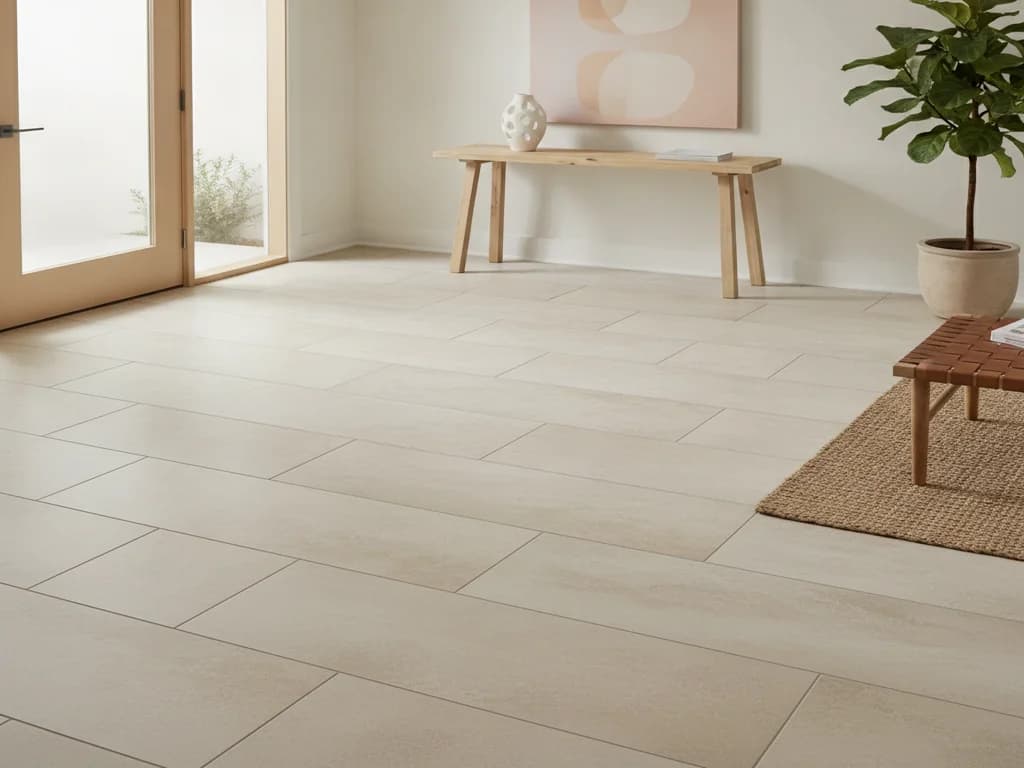
A straight grid of square tile in an open room is the fastest layout. Diagonal runs, herringbone, and lots of doorways and cabinet cuts all take more time. Rectangular plank-style tile adds a specific issue: TCNA explains that tile is often made slightly domed, so a 50 percent offset puts the high center of one tile next to the low edge of another, and large tiles at the edge of their allowed warpage are guaranteed to show lippage at that offset. TCNA's guidance is to reconsider the amount of offset and widen the grout joint. Settling the pattern before the quote lets the estimate reflect it.
If you are still deciding between materials, our LVP vs. tile and hardwood vs. tile comparisons cover where each one belongs, and our tile flooring page covers what we install.
Getting an Accurate Number
A planning range is useful for budgeting. It can't tell you how stiff your floor is, how cracked your slab is, or how far out of flat the room is, and those usually decide where you land in the range. Getting a real number takes someone checking the floor in person with a straightedge.
If you'd like an honest, no-pressure estimate for tile flooring in your home, Renaissance Floors serves Roseville and the Greater Sacramento & Northern California area. Call (916) 749-0272 or request a free estimate — we'll give you a real number based on what's actually in your home.
This article is part of our guide to what flooring actually costs, which covers how flooring is priced, what moves the number, and where the money goes that nobody quotes for.
Sources
- TCNA — FAQ: Deflection
- Ceramic Tile Education Foundation — Caution: Natural Stone Tile Installed Over Wood Framing
- TCNA — FAQ: Crack Isolation / Suppression / Anti-fracture Membrane
- TCNA — FAQ: Cracked Tile
- TCNA — ANSI Standards (current editions and titles)
- TCNA — 2013 TCNA Handbook Addresses Concrete Slabs That Don't Meet Flatness Tolerances
- TCNA (Tile Q&A) — An "Expanded" Look into Large Format Tile, Part 2
- TCNA — FAQ: Lippage
- TCNA — FAQ: Thinset / Dryset Mortar
- TCNA — FAQ: Movement Joint Placement, Spacing, and Tenting
- TCNA — FAQ: Porcelain vs. Non-Porcelain
- TCNA — Dynamic Coefficient of Friction FAQ
Explore related
Good to Know
Frequently Asked Questions
How much does tile flooring cost to install?
For planning in the Greater Sacramento and Northern California area, installed tile runs about $10–$20 per square foot. Removing and hauling away the existing floor is separate, roughly $1–$3 per square foot. Where a project lands depends mostly on substrate prep, membranes, tile size, and layout, which is why an in-home measurement is the only exact number.
Why is large-format tile more expensive to install?
Large tile magnifies any unevenness in the floor. Thin-set mortar is not meant to level a floor, so the tile follows the plane beneath it, and TCNA guidance allows larger tile only an eighth of an inch of variation in 10 feet. Meeting that usually means grinding, patching, or self-leveling underlayment, plus mortars made for large, heavy tile and more careful setting.
Does my subfloor need to be reinforced for tile?
Sometimes. TCNA's traditional minimum for a wood-framed floor that will be tiled is L/360 deflection, and natural stone is held to a stiffer L/720, typically with two layers of structural wood panel when backer board is the substrate. A floor that bounces, especially between joists, may need added subfloor or underlayment work before tile goes down.
Do I need a crack-isolation membrane under tile on a concrete slab?
It depends on the slab. When tile is bonded directly to concrete, cracks in the slab tend to show up in the tile, which TCNA calls reflective cracking. A crack-isolation membrane meeting ANSI A118.12, or a mortar bed over a cleavage membrane, prevents that. Some slabs need only spot treatment over cracks, while others warrant full coverage.
Can tile be installed over existing tile to save on tear-out?
Sometimes. TCNA says tiling over existing ceramic tile is done regularly where the old tile is well bonded and there is no floor-height limitation, following specific TCNA Handbook procedures and often a bond test. The added height has to be checked at doorways, appliances, and stair nosings, and those details sometimes cost more than removal.
Is porcelain tile harder to install than ceramic?
Somewhat. TCNA defines porcelain as tile with water absorption of 0.5 percent or less, and notes that porcelain is harder to bond and harder to cut than non-porcelain tile. It makes little difference to the finished floor as long as the installer uses the right mortar and tools, but it can affect labor time on a quote.
What slip rating should tile have for a kitchen or bathroom floor?
Look for tile classified Interior, Wet under ANSI A326.3-2021, which requires a wet dynamic coefficient of friction (DCOF) of at least 0.42 or a manufacturer declaration. The earlier version of the standard set the same 0.42 minimum for level interior floors expected to be walked on when wet. Tile below that belongs where it stays dry.
Why does a tile quote include movement joints?
The TCNA Handbook calls for allowing for expansion and contraction in every tile installation, with placement guidelines in detail EJ171. Small rooms may only need a hidden perimeter gap, while larger or sunny areas need visible joints. TCNA links tile tenting, where tile heaves off the floor, to movement joints that were not used enough.
Does removing old tile cost more than removing carpet?
Yes, generally. Carpet and pad come up quickly, while tile set in mortar is slow, heavy work with more disposal, so it sits at the high end of the roughly $1–$3 per square foot removal range. Glue-down carpet adhesive and some old black cutback adhesives also need removal or special treatment before new tile can bond.
Ready to price it for your house?
See how we install tile flooring or skip ahead: a free in-home estimate means Alex measures the rooms, checks the subfloor, and quotes the exact product — no planning ranges.
Local pages for tile flooring: Auburn, Folsom, Roseville, Santa Rosa, Sacramento, Oakland, San Rafael and San Jose.
Written by
Owner & Lead Installer, Renaissance Floors
15+ years of hands-on flooring experience across Greater Sacramento & Northern California. Works on hardwood and engineered installation, refinishing, subfloor preparation, and moisture testing — and writes these guides from what the jobs actually teach.
Licensed California contractor, CSLB C-15 license #1060673(verify ↗)


Related
Keep Reading
Related pages: What It Costs, Journal, American Walnut, and Wide-Plank Flooring.

Ready for Floors You'll Love?
Ready to talk through your project? Free estimates throughout Greater Sacramento & Northern California.