Comparison
Epoxy vs. Polyaspartic Garage Floor Coatings
Epoxy or polyaspartic garage floor coating: which lasts, and what is the difference?
Epoxy or polyaspartic garage floor coating: which lasts, and what is the difference?
For most garages the best answer is both: an epoxy base coat bonded to ground concrete, under a clear polyaspartic topcoat. The two are different chemistries with different strengths. Epoxy is a two-part product, an epoxy resin mixed with a hardener that is generally a polyamine, and EU-OSHA lists "excellent adhesion to many substrates" among its properties. Its weakness is sunlight. NIST researchers note that epoxy-based materials "are known to undergo degradation when exposed to UV radiation," which shows up as gloss loss, thinning and cracking. Polyaspartic is a polyurea: a polyisocyanate component reacting with a polyaspartic ester. The American Chemistry Council's diisocyanates panel says aliphatic isocyanates such as HDI are used where coatings must stay color-stable and resist UV, so a polyaspartic built on them suits a sunlit top layer. As for which lasts: neither chemistry survives bad prep. Most garage coatings that fail let go at the bond to the concrete, not through the top.
Spec sheets for both are built on the same ASTM tests, which makes direct comparison possible when you ask for the numbers. ASTM D7234 measures pull-off adhesion of a coating on concrete, the bond that decides whether a floor peels. ASTM D4060 measures abrasion resistance with a Taber Abraser on a flat test panel, so it ranks coatings against each other but does not test your slab. ASTM D1308 covers household chemicals and records discoloration, gloss change, blistering, softening, swelling and loss of adhesion. Compare two products only when both report the same test run the same way. A brochure word like "industrial strength" is not a test result.
Speed is polyaspartic's other main draw. It generally cures and returns to service faster than epoxy, which also means less working time once mixed, and heat shortens it further. The product's data sheet sets the real pot life, recoat window and time until a car can park, so plan from that document, not from the chemistry's reputation. Both have to go on mechanically ground concrete that has passed a moisture test, because a coating cannot fix a wet or slick slab. Both also call for care during application. EU-OSHA calls epoxy products "potent skin sensitizers," and polyaspartic's hardener contains isocyanates, which OSHA ties to occupational asthma. In Greater Sacramento, Sacramento Metropolitan AQMD Rule 442 caps floor coatings at 100 grams of VOC per liter. That limit covers either chemistry.
Decision Framework
When Each One Wins
Conditions, not preferences. If one of these describes your project, it should carry more weight than anything else on this page.
Choose Epoxy when…
- The base and color coat bonded directly to ground concrete. EU-OSHA lists "excellent adhesion to many substrates" and resistance to mechanical wear among epoxy's properties, which is the job a first coat has.
- Flake broadcast systems, where colored flakes are broadcast into a wet base coat and then sealed under a clear top.
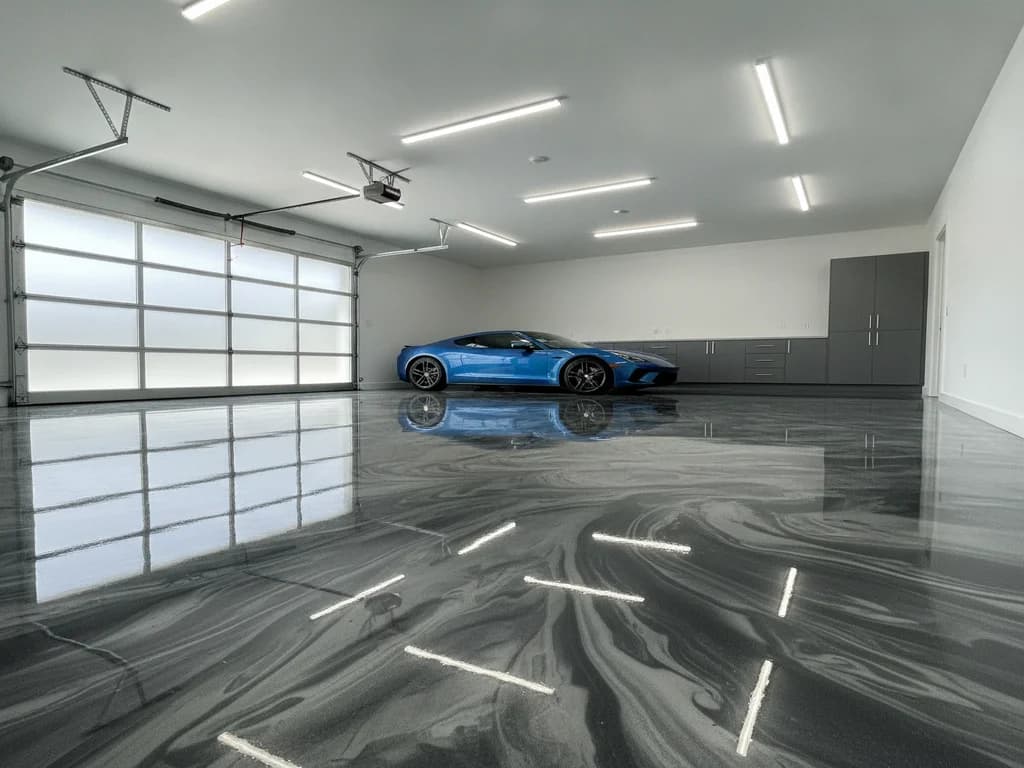
- Metallic and other decorative looks that need a pigmented resin coat to work in.
- Interior floors with no direct sun, such as basements, shops and garages with a north-facing or usually closed door, where epoxy's UV weakness matters least.
- Larger floors and slower, more careful work, where a longer working time after mixing helps keep wet edges and an even finish.
- Projects where isocyanate-containing products are ruled out. Epoxy has no isocyanate hardener, though EU-OSHA's guidance treats epoxy itself as a serious skin-allergy risk.
Choose Polyaspartic when…
- The clear topcoat over an epoxy or flake base, which is how we recommend using it on most residential garages.
- Garages where afternoon sun reaches the floor through an open door. NIST notes that epoxy degrades under UV, while the American Chemistry Council's diisocyanates panel says aliphatic isocyanates are used for color-stable, UV-stable coatings.
- Light-colored floors and clear coats over light flake, where any color shift on the top layer would show first.
- Tight schedules. Faster cure means vehicles back in sooner, on the timeline the product's data sheet gives.
- Shops and commercial floors where every day out of service costs money, as long as the crew can work within a shorter pot life.
- A clear wear layer over a decorative base, so the base coat is not the layer taking abrasion and chemical contact, and the top can be renewed later over a sound floor.
Side by Side
The Properties That Actually Differ
Where a figure is set by an individual product's instructions rather than by the material itself, the property is described as a relationship. An invented number would be worse than no number.
| Property | Epoxy | Polyaspartic |
|---|---|---|
| What it is | Two parts mixed on site: an epoxy resin and a hardener, generally a polyamine (EU-OSHA OSHwiki). | A polyurea: a polyisocyanate component plus a polyaspartic ester (U.S. patent record US 6,458,293). |
| Usual role in a garage system | Primer, base coat and color coat. Flakes are broadcast into it while it is wet. | Clear topcoat over the epoxy or flake base. Some products are sold as full systems; the data sheet says which. |
| Bond to concrete | EU-OSHA lists "excellent adhesion to many substrates." The bond still depends on the profile and moisture of the slab. | Depends on the product and the prep. Many systems put an epoxy primer or base under it. ASTM D7234 measures pull-off adhesion on concrete for either. |
| Working time and cure | Slower. More time to work after mixing; a longer wait before parking. | Faster. Less time to work after mixing, shorter still in heat; earlier return to service. The data sheet sets the numbers. |
| Sunlight (UV) | NIST: epoxy-based materials are known to degrade under UV, with gloss loss, thickness loss and cracking. | Aliphatic isocyanates such as HDI are used for UV stability and color-stable coatings (American Chemistry Council diisocyanates panel). Check that the data sheet says aliphatic. |
| Abrasion rating | ASTM D4060 (Taber Abraser) on a flat test panel. Ask for the result. | Same test, same caution: it ranks coatings in the lab and does not test your slab. |
| Household and garage chemicals | ASTM D1308 records discoloration, gloss change, blistering, softening, swelling and loss of adhesion. Ask which chemicals were tested. | Same test method. Compare only results for the same chemicals and exposure. |
| Hot tire pickup | A catalyzed two-part coating, and catalyzed coatings generally resist the tire-chemical softening that one-part floor paints can suffer. Pickup mostly traces to weak bond or incomplete cure. | Also catalyzed, so the same applies. A topcoat does not save a base that never bonded. |
| Surface prep | Grind or shot-blast to the ICRI Concrete Surface Profile on the data sheet. ICRI's chips run from CSP 1 (acid-etched) and CSP 2 (grinding) to CSP 10. | Same. The topcoat is only as good as what it sits on. |
| Slab moisture | Test bare concrete first: ASTM D4263 (plastic sheet), F1869 (calcium chloride) or F2170 (in-slab RH), against the product's limit. | Same tests, same rule. Neither coating stops moisture coming up through the slab. |
| Applicator health | "Potent skin sensitizers" (EU-OSHA). It cites a Dutch estimate that one in five workers who often use epoxies, such as floor layers, develops an epoxy allergy. | The hardener contains isocyanates. OSHA lists occupational asthma among the main effects; EU-OSHA notes skin risk remains even with roller application. |
| Once fully cured | EU-OSHA: fully cured epoxies "generally turn into much less toxic polymers." | The exposure risk is during mixing and application. Keep people and pets out for the cure time on the data sheet. |
| VOC limit in Greater Sacramento | SMAQMD Rule 442 caps floor coatings, a category that names garage floors, at 100 g/L, dropping to 50 g/L if the rule's contingency measure is triggered. | Same rule. The category on the label decides which limit applies to a clear topcoat. |
| Application conditions | Within the data sheet's temperature and humidity range. Coating a warming slab in direct sun can trap air bubbles and pinholes. | Same, and heat cuts working time further. Hot Sacramento Valley afternoons are usually the wrong time to roll it. |
| Recoat and repair | Sand the whole surface to remove gloss and check adhesion before a new coat. Failed areas are ground out. | Same approach. A sound floor that is only dull can take a fresh topcoat. |
It Depends
The Variables That Decide It
No comparison answers this for every house. These are the specific things about your project that move the answer, and they are worth establishing before you shop.
How much sun reaches the floor
This decides whether epoxy can be the exposed top layer. NIST researchers note that amine-cured epoxy photo-oxidizes under UV, losing gloss and thickness and cracking over time. A garage whose door faces west and stays open on summer afternoons gets that exposure on the first few feet of floor. A basement or a closed garage gets almost none. Where sun is real, put a clear aliphatic topcoat over the epoxy. Polyaspartic is the usual choice, and its data sheet should say aliphatic.
The condition of the slab
Coating chemistry matters less than the concrete underneath. Both coatings need a mechanically ground or shot-blasted surface at the ICRI Concrete Surface Profile the data sheet calls for, not an acid-etched or washed slab. Both need moisture testing on bare concrete: ASTM D4263 as a quick check, F1869 or F2170 for a number to compare with the product's limit. ASTM D4263 notes that capillary moisture can be detrimental to coatings that cannot tolerate it. A slab that fails needs moisture mitigation first, whichever topcoat you choose.
Schedule and weather
Polyaspartic's faster cure is a real advantage when the garage has to be back in use quickly. The same speed shortens the time the crew has to spread it, and heat shortens it further. In a Sacramento Valley summer we plan coating work for the cooler part of the day and keep it out of direct sun, which also avoids the off-gassing bubbles that form when a warming slab pushes air into a wet coat. Epoxy's slower set gives more time to work and needs a longer wait before parking.
The look you want
Decorative systems are built in the base. Flake broadcast floors get their color from flakes set into a wet base coat, and metallic floors are pigmented epoxy. The topcoat is clear and protects that layer. So the question is often not epoxy or polyaspartic, but which base and which top. Choose the look first, then make sure the exposed top layer suits the floor's sun and wear.
Who is applying it
Both chemistries carry real handling hazards before they cure. EU-OSHA calls epoxy products potent skin sensitizers, cites Finnish data ranking epoxy compounds as the leading cause of occupational skin disease among construction workers, and says workers who develop the allergy face a stronger reaction with each contact. Polyaspartic hardeners contain isocyanates, which OSHA links to occupational asthma and skin irritation, and EU-OSHA notes that skin effects remain a concern even with brush or roller application. Gloves, sleeves, eye protection and ventilation are not optional with either. Fast-curing polyaspartic also gives an inexperienced applicator very little room for error.
What the data sheet actually says
Garage coating names are loose, and the technical data sheet is where the facts live. Check whether a polyaspartic is aliphatic, whether an epoxy is a true two-part product, what surface profile and moisture limit each requires, the pot life and recoat window at your temperature, and the cure time before vehicle traffic. Also check the coating category and VOC content against Sacramento Metropolitan AQMD Rule 442. Ask for ASTM D7234 adhesion, D4060 abrasion and D1308 chemical results if you are comparing products.
On this site: Epoxy Garage Floors, Epoxy Peeling and Hot Tire Pickup, Moisture Under Flooring, Finish Wear, Sun Fading, Commercial Flooring, Floor Finder, and Flooring Glossary.
Next decision: Water-Based vs. Oil-Based Poly, Porcelain vs. Ceramic, and LVP vs. Tile.
See all 22 flooring comparisons, or look up a term in the glossary.
Common Questions
Frequently Asked Questions
Is polyaspartic better than epoxy?
For the top layer of a garage floor, usually yes, if the product is aliphatic. NIST notes that epoxy degrades under UV, losing gloss and thickness, while aliphatic isocyanates are used for color-stable, UV-stable coatings. For the coat bonded to the concrete, epoxy is a strong choice; EU-OSHA lists excellent adhesion among its properties. That is why many garage systems use both: epoxy base, polyaspartic top.
Which lasts longer, epoxy or polyaspartic?
No standard or agency we found gives a lifespan in years for either. What decides how long a garage coating lasts is mostly the bond: whether the slab was ground to the right profile, tested for moisture, and coated within the product's conditions. After that, a UV-stable topcoat matters where sun reaches the floor, and abrasion and chemical results (ASTM D4060 and D1308) help compare products.
What is polyaspartic, exactly?
It is a type of polyurea. A polyisocyanate component reacts with a polyaspartic ester to form the coating, as patent records for these coatings describe. The polyisocyanate is the isocyanate-containing hardener, which is why OSHA's isocyanates guidance applies during mixing and application. For a garage topcoat, look for "aliphatic" on the data sheet; that is the isocyanate type used for UV-stable, color-stable coatings.
Does epoxy turn yellow in the sun?
Epoxy breaks down under ultraviolet light. NIST researchers describe amine-cured epoxy photo-oxidizing under UV, with gloss loss, thinning and cracking. How fast and how visibly depends on the product and how much sun the floor gets. The usual fix is a clear aliphatic topcoat over the epoxy rather than leaving epoxy as the exposed surface.
Can polyaspartic go straight onto concrete without epoxy?
Some products are made for that, and the data sheet will say so along with its required surface profile and moisture limit. Many systems still use an epoxy primer or base coat under it. Either way, the concrete has to be mechanically ground to the specified ICRI profile and pass moisture testing on bare concrete first.
How soon can I park on a new epoxy or polyaspartic floor?
Use the cure table on the product's data sheet, at the temperature the floor actually sees. Polyaspartic generally returns to service faster than epoxy. Parking early on a coating that is not fully cured, especially with hot tires, is one of the common causes of tire marks and pickup.
Does polyaspartic prevent hot tire pickup?
Not on its own. Both epoxy and polyaspartic are catalyzed two-part coatings, and catalyzed coatings generally resist the softening from tire chemicals that one-part floor paints can suffer. Pickup usually means the coating was not bonded well or not fully cured. A good topcoat over a base that never gripped the concrete still lifts.
Do I need to test my garage slab for moisture before coating?
Yes, for either coating. ASTM D4263 is a plastic-sheet check for capillary moisture, designed for use before coating concrete. ASTM F1869 gives a moisture emission rate in pounds per 1,000 sq ft per 24 hours, and F2170 measures relative humidity inside the slab. F1869 cannot be run over an existing coating, so testing happens on bare concrete.
Are these coatings safe to apply myself?
They can be applied safely with the right protection, but both are hazardous before they cure. EU-OSHA calls epoxy products potent skin sensitizers, and polyaspartic hardeners contain isocyanates, which OSHA links to occupational asthma. EU-OSHA notes skin risk remains even with roller application. Fast-curing polyaspartic is also unforgiving to apply. Read the safety data sheet first, and keep children and pets away until the coating has cured.
Are VOC rules in Sacramento different for these coatings?
The same rule covers both. Sacramento Metropolitan AQMD Rule 442 limits floor coatings, a category that names garage floors, to 100 grams of VOC per liter, with a lower 50 g/L limit if the rule's contingency measure is triggered. Other California air districts have their own rules. The coating category on the label determines which limit applies.
Sources
Where These Specifics Come From
Industry guidelines, manufacturer instructions, and regulations cited on this page.
- Rezig et al., Relationship between Chemical Degradation and Thickness Loss of an Amine-cured Epoxy Coating Exposed to Different UV Conditions — epoxy degrades under UV; gloss loss, thickness decrease, crackingNational Institute of Standards and Technology
- OSHwiki: Occupational exposure to epoxy resins — resin plus polyamine hardener, adhesion and wear properties, skin allergy in floor layers, cured epoxyEuropean Agency for Safety and Health at Work (EU-OSHA)
- OSHwiki: Isocyanates — skin and respiratory sensitisers, isocyanate in the hardener of 2-pack products, skin risk with roller applicationEuropean Agency for Safety and Health at Work (EU-OSHA)
- Isocyanates — health effects, occupational asthma, surface coatingsOccupational Safety and Health Administration
- Fast Facts and FAQs — aliphatic polyisocyanates for color-stable coatings; HDI for UV stability, used in flooringAmerican Chemistry Council, Aliphatic Diisocyanates Panel
- US 6,458,293 B1 — polyurea coating from a polyisocyanate component and a polyaspartic ester mixtureU.S. Patent and Trademark Office (via Google Patents)
- Measuring Concrete Surface Profile — ICRI Guideline 310.2R CSP 1–10 chips and the preparation each representsKTA-Tator
- D7234 — Pull-Off Adhesion Strength of Coatings on Concrete Using Portable Pull-Off Adhesion Testers (scope)ASTM International
- D4060 — Abrasion Resistance of Organic Coatings by the Taber Abraser (scope)ASTM International
- D1308 — Effect of Household Chemicals on Clear and Pigmented Organic Finishes (scope)ASTM International
- D4263 — Indicating Moisture in Concrete by the Plastic Sheet Method (scope)ASTM International
- F1869 — Moisture Vapor Emission Rate of Concrete Subfloor Using Anhydrous Calcium Chloride (scope)ASTM International
- F2170 — Relative Humidity in Concrete Floor Slabs Using in situ Probes (scope)ASTM International
- Rule 442, Architectural Coatings (amended 7-25-24) — floor coating definition and Table 1 VOC limitsSacramento Metropolitan Air Quality Management District
Ready to price it for your house?
See how we approach epoxy garage floors, check flooring cost guide, or skip ahead: a free in-home estimate means Alex measures the rooms, checks the subfloor, and quotes the exact product — no planning ranges.
Comparison written by
Owner & Lead Installer, Renaissance Floors
15+ years of hands-on flooring experience across Greater Sacramento & Northern California. Works on hardwood and engineered installation, refinishing, subfloor preparation, and moisture testing — and writes these guides from what the jobs actually teach.
Licensed California contractor, CSLB C-15 license #1060673(verify ↗)

Get a Straight Answer for Your House
Free estimates across Greater Sacramento & Northern California. We'll look at your subfloor and your rooms and tell you which of these actually fits — call (916) 749-0272.