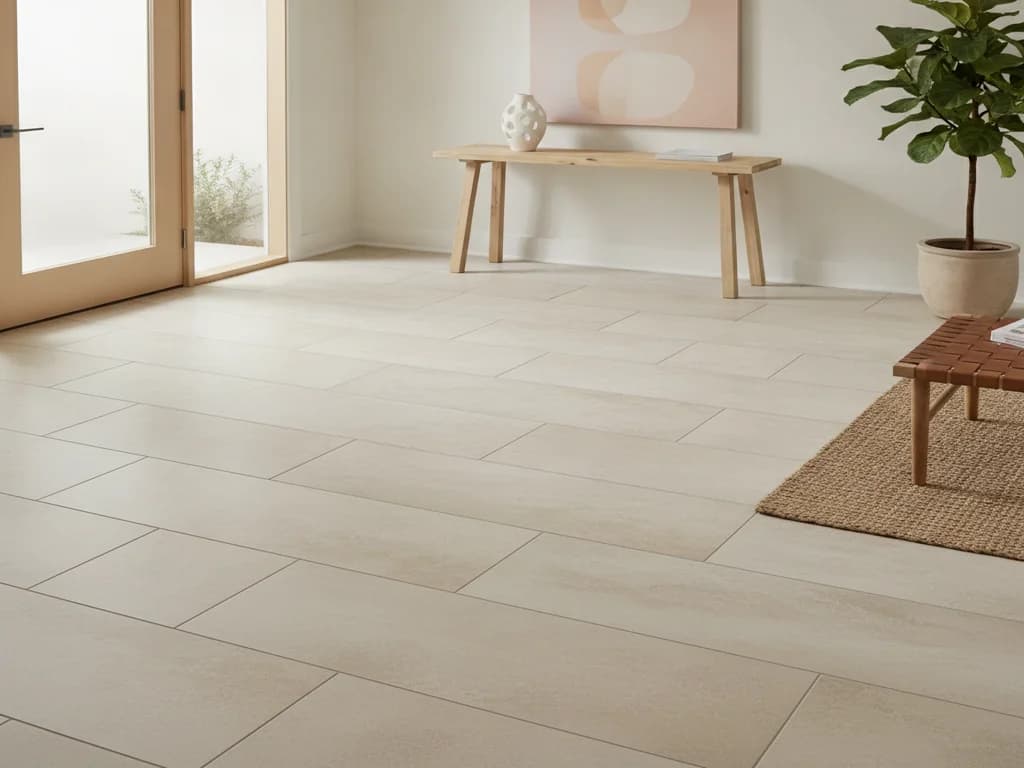
Comparison
Luxury Vinyl Plank vs. Tile
LVP or tile: which is better for kitchens, bathrooms and slabs?
LVP or tile: which is better for kitchens, bathrooms and slabs?
Choose tile for showers, wet bathrooms and entries, and for floors you want to keep a long time. Choose luxury vinyl plank (LVP) where comfort, quiet and budget matter more, and over wood-framed floors that are too springy for tile. Both handle a kitchen. The difference is the material. Tile is fired ceramic. Porcelain tile, by the definition TCNA cites, has a water absorption of 0.5% or less. LVP is a printed decor under a clear wear layer on a vinyl or polymer core (ASTM F1700 and F3261). Tile is hard, rigid and heavy. LVP is softer and floats or glues down. As planning ranges, LVP runs about $5–10 per sq ft installed and tile about $10–20.
Most tile problems start below the tile, not in it. Tile is rigid, so it needs a stiff, flat floor. TCNA's FAQ gives L/360 as the traditional minimum for a framed floor: on a 10-foot joist span, no more than about 1/3 inch of deflection. Over concrete, TCNA notes that cracks in the slab "reflect" up through bonded tile, so a crack isolation membrane or a mortar bed over a cleavage membrane is the fix. Every tile floor also needs soft movement joints; the TCNA FAQ ties tented tile to missing ones. LVP has the opposite weakness. It does not care much about a stiff floor, and ASTM F3261 allows an attached backer that reduces issues with minor subfloor irregularities. But it does care about moisture coming up from a slab. RFCI's moisture guide says every concrete floor, of any age and grade level, should be tested before resilient flooring goes down.
Neither floor is a waterproof assembly by itself. Water that gets through LVP seams reaches the subfloor. Tile in a shower relies on a waterproof membrane behind it; two of the TCNA Handbook's shower methods, B421 and B422, apply one over a solid backing. For slip resistance in kitchens and baths, ask for the product's ANSI A326.3 wet DCOF or its product use class. The standard sets 0.42 wet DCOF for level interior floors walked on when wet, and the standard is written for hard surface flooring materials, not only tile, so ask the LVP maker too. A tile floor can be repaired one tile at a time but cannot be refinished. LVP cannot be refinished either; worn planks are replaced.
Decision Framework
When Each One Wins
Conditions, not preferences. If one of these describes your project, it should carry more weight than anything else on this page.
Choose Luxury vinyl plank when…
- Kitchens where people stand for hours. LVP is softer and warmer underfoot, and a dropped glass has a better chance on it.
- Second floors and raised-foundation homes with springy floors. Tile needs a framed floor stiff enough to meet TCNA's L/360 guideline; a floating plank does not.
- Bedrooms, family rooms and condos where noise matters. ASTM F3261 lets rigid-core plank carry an attached underlay backer for reduced noise.
- Budgets. As planning ranges, LVP runs about $5–10 per sq ft installed against about $10–20 for tile.
- Fast installs over existing floors. A floating plank goes down without mortar cure time, and the attached backer in F3261 helps over minor subfloor irregularities.
- Laundry rooms and half baths where water is occasional and the main worry is a spill, not a shower spray.
Choose Porcelain or ceramic tile when…
- Showers and wet bathrooms. The TCNA Handbook has shower methods, such as B421 and B422, that set tile over a waterproof membrane.
- Entries and mudrooms that take wet boots and grit. TCNA's FAQ calls through-body porcelain "harder than granite" and says its color goes all the way through.
- Slab-on-grade homes where the slab is sound. Tile bonds to concrete, and porcelain absorbs 0.5% or less water by definition.
- Rooms behind big, hot glass. Tile does not soften or curl with heat the way vinyl can; ASTM F2199 exists to measure that change in resilient plank.
- Floors you want to keep a long time. Unglazed through-body porcelain has no print layer to wear through; TCNA says these tiles "tend not to show wear."
- Radiant floor heat, where tile is the traditional partner. Still confirm the setting materials and membrane are approved for it.
Side by Side
The Properties That Actually Differ
Where a figure is set by an individual product's instructions rather than by the material itself, the property is described as a relationship. An invented number would be worse than no number.
| Property | Luxury vinyl plank | Porcelain or ceramic tile |
|---|---|---|
| What it is | Printed decor under a clear wear layer. Flexible LVP is solid vinyl (ASTM F1700). Rigid-core LVP has a polymeric rigid core (ASTM F3261). | Fired clay tile. Porcelain absorbs 0.5% or less water by ASTM C373; non-porcelain ceramic absorbs more (TCNA). |
| Water on the surface | The plank itself is not harmed by spills or wet mopping. | The tile itself is not harmed. Porcelain is dense and nearly impervious. |
| Water through the floor | Seams are not seals. Water that gets through reaches the subfloor and dries slowly under the plank. | Grout joints are not a waterproof layer. In showers, TCNA Handbook methods B421 and B422 use a waterproof membrane under the tile. |
| Showers | Not a shower-pan or shower-wall material. | Yes, over a waterproof membrane and suitable backing (TCNA Handbook shower methods). |
| Slip resistance | Ask for the ANSI A326.3 wet DCOF or product use class. The standard covers hard surface flooring materials, not only tile. | ANSI A326.3: at least 0.42 wet DCOF for level interior floors walked on when wet, unless the maker declares otherwise. TCNA notes unglazed porcelain may have better slip resistance. |
| Surface wear rating | Wear-layer thickness in mils, measured by ASTM F410. | Visible surface abrasion by ASTM C1027. TCNA says glaze hardness varies, so check that the tile was tested for your use. |
| Dents and drops | Can dent under heavy narrow feet; ASTM F1914 measures residual indentation. Dropped items often survive. | Does not dent. A heavy drop can chip or crack a tile; ASTM C648 measures breaking strength. |
| Heat and sun | Vinyl moves with temperature. ASTM F2199 measures dimensional change and curling after heat exposure. | Stable, but the tile layer still expands. TCNA says movement joints are especially important in sunny rooms. |
| Floor stiffness needed | Low. Floating rigid core tolerates normal framed floors; F3261 allows a backer for minor irregularities. | High. TCNA's traditional minimum is L/360 before the tile underlayment goes in (about 1/3 in on a 10 ft span). |
| Over a concrete slab | Test moisture first: ASTM F1869 (calcium chloride) or F2170 (in-slab RH) against the maker's limit. RFCI flags pH above 10 as possibly needing correction. | Slab cracks reflect through bonded tile. Use a crack isolation membrane or a mortar bed over a cleavage membrane (TCNA). TCNA does not recommend tiling over a control joint. |
| New concrete | No fixed age. RFCI says test for moisture regardless of age. | TCNA notes many people suggest at least a 28-day cure before tiling, and says no single cure time can be stated. |
| Over plywood or OSB | Normal for floating plank over a flat, sound subfloor. | TCNA's FAQ says the A108 standards exclude OSB and thinset makers do not recommend tile bonded directly to it. Use a Handbook method with a backer or membrane. |
| Sound and feel | Softer, warmer and quieter, especially with an attached backer (ASTM F3261). | Hard and cool underfoot. Loud with hard shoes. |
| Repair | Replace planks. Keep a box from the original run, because print runs drift. | Replace individual tiles. TCNA says epoxy injection under hollow tile is not practical over a large area. |
| Installed cost (planning range) | About $5–10 per sq ft installed. | About $10–20 per sq ft installed. |
It Depends
The Variables That Decide It
No comparison answers this for every house. These are the specific things about your project that move the answer, and they are worth establishing before you shop.
How wet the room really gets
A shower floor or a tub surround is tile's job. A bathroom with only a vanity and toilet, a laundry room or a kitchen sees spills and the occasional leak, and either floor handles that on the surface. The difference is what happens under it. Water that gets into LVP seams sits on the subfloor under a vapor-resistant plank. Water through grout reaches the setting bed. In a full bathroom with a shower, tile with a properly built wet area is the safer call. In a powder room or laundry, LVP is a fair choice.
How stiff the floor is
This decides more tile jobs than anything else. TCNA's FAQ gives L/360 as the traditional minimum for a framed floor, measured before the tile underlayment, and warns that deflection between joists can exceed it even when the joists meet code. It also says tile has failed at L/600 under some conditions, which is why TCNA's recommendations rely on tested Handbook methods, not a deflection number alone. Older raised-foundation homes with crawlspaces and longer spans often need work before tile. LVP floats over the same floor without that work.
What the slab is doing
Many Sacramento Valley tract homes are slab-on-grade, and each floor has its own slab risk. For tile, the risk is movement. TCNA's FAQ says slab cracks reflect through bonded tile, recommends against tiling over control joints, and points to crack isolation membranes or a mortar bed over a cleavage membrane. For LVP, the risk is moisture. RFCI's guide lists shifting, peaking or curling of planks and microbial growth among the problems excess slab moisture causes, and it names ASTM F1869 and F2170 as the tests. Test before choosing either one.
Heat, sun and movement joints
Hot afternoons behind west-facing glass affect both floors. Vinyl expands with heat, and ASTM F2199 measures how resilient plank changes and curls after heat exposure. Ask for that result for a sunroom or slider. Tile expands too, and TCNA's FAQ says tile that tents up is often a sign movement joints were not used enough. It adds that heat is one of the forces that drives it. A tile floor needs soft joints at the perimeter and in the field. An LVP floor needs its full expansion gap at every wall.
Porcelain or ceramic
"Tile" covers two materials. Porcelain absorbs 0.5% or less water by ASTM C373, which makes it denser and usually frost resistant. TCNA's FAQ adds that porcelain is harder to bond and harder to cut, while non-porcelain ceramic is easier to bond and cut and comes in a wide range of glazes, so check that the glaze hardness suits the room. If a box says porcelain, the Porcelain Tile Certification Agency (PTCA) mark, from a program TCNA and the CTDA launched, certifies that it is.
Comfort and who lives there
Tile is hard and cool. That is pleasant in a hot summer and tiring at a kitchen counter for hours. LVP is softer and quieter, which matters in bedrooms, upstairs rooms and condos. Small children and older adults may also prefer a floor where a fall or a dropped dish is less punishing. Slip resistance matters for both. Ask for an ANSI A326.3 wet DCOF result or an Interior, Wet product use class for any kitchen or bath floor.
On this site: Luxury Vinyl Plank, Tile Flooring, Journal: tile vs. luxury vinyl for bathrooms, Best Flooring for Kitchens, Tile Cracks, Tile Tenting, Vinyl Plank Separating, Moisture Under Flooring, Radiant Heat Flooring, Caring for Tile, and Caring for Luxury Vinyl Plank.
Next decision: Porcelain vs. Ceramic, Hardwood vs. Tile, and LVP vs. Laminate.
See all 22 flooring comparisons, or look up a term in the glossary.
Common Questions
Frequently Asked Questions
Is LVP or tile better for a bathroom?
Tile for a full bathroom with a shower, and especially for the shower itself, where the TCNA Handbook's methods put a waterproof membrane behind the tile. LVP is a reasonable choice for a powder room or a bathroom with no shower, where water is limited to splashes and the occasional overflow. In either case, ask for the floor's ANSI A326.3 wet DCOF or product use class.
Is LVP or tile better for a kitchen?
Both work. Tile is harder and does not dent, but it is tiring to stand on and unforgiving of dropped dishes. LVP is softer and quieter, but a slow leak under a dishwasher or refrigerator can reach the subfloor through its seams. If the kitchen is on a stiff slab and you want the longest-lived surface, choose tile. If comfort and budget lead, choose LVP. As planning ranges, LVP runs about $5–10 per sq ft installed and tile about $10–20.
Which is better on a concrete slab?
Either, once the slab is checked for the risk that matters to each. For LVP, that is moisture. RFCI's moisture guide says every concrete floor should be tested regardless of age, using ASTM F1869 or F2170 against the product maker's limit. For tile, that is cracking and movement. TCNA's FAQ says slab cracks reflect through bonded tile and recommends a crack isolation membrane or a mortar bed over a cleavage membrane.
Is tile waterproof?
Porcelain tile is nearly impervious, absorbing 0.5% or less water by the ASTM C373 test. A tile floor is not automatically waterproof, though. Water can pass through grout joints into the setting bed. Where waterproofing matters, as in a shower, the TCNA Handbook's methods include a waterproof membrane under the tile.
Is waterproof LVP really waterproof?
The plank is. The floor is not sealed. Water that gets through the seams reaches the subfloor, and under a vapor-resistant plank it dries slowly. Find and stop leaks quickly, and do not use LVP as a shower floor.
Why does tile crack?
Usually because of what is under it. TCNA's FAQs name slab cracks reflecting through bonded tile, tile set over control joints, too much floor deflection, missing movement joints and poor thinset coverage among the causes. Cracked tile is usually a substrate or installation problem, not a bad batch of tile.
Can tile go on a second floor or over a wood subfloor?
Yes, if the floor is stiff enough. TCNA's traditional minimum is L/360, measured before the tile underlayment. On a 10-foot span, that is no more than about 1/3 inch of deflection. TCNA's FAQ also says the A108 standards exclude OSB and thinset makers do not recommend bonding tile directly to it. A TCNA Handbook method with the right backer or membrane is the way to do it.
Can I put tile or LVP over my old vinyl floor?
Sometimes. TCNA's FAQ says specialty thinsets bond to sheet vinyl, but the whole subfloor under it still has to meet tile's requirements. Floating LVP can often go over a flat, well-bonded old floor if the maker allows it. In both cases, check what the old floor is made of before disturbing it. In older homes, have it tested before sanding or tearing it out.
Which one is slippery when wet?
It depends on the product, not the category. ANSI A326.3 sets 0.42 wet DCOF as the threshold for level interior floors expected to be walked on when wet, and its Interior, Wet class names home kitchens and bathrooms among possible areas of use. Older tile spec sheets may cite ASTM C1028, a static friction test that ASTM withdrew in 2014. Ask for the A326.3 number instead.
Which is easier to repair?
Both repair one unit at a time. A damaged LVP plank is swapped, which is easiest on a floating floor. A cracked tile is cut out and reset, and matching grout and tile is the hard part. Keep spare material from the original run for either one. TCNA's FAQ notes that epoxy injection under hollow tile may work in a small area but is not practical over a large one, and a repair that does not fix the cause will not last.
Sources
Where These Specifics Come From
Industry guidelines, manufacturer instructions, and regulations cited on this page.
- FAQ: Porcelain vs. Non-Porcelain — 0.5% water absorption by ASTM C373, glazed vs. unglazed, bonding and cutting, through-body porcelainTile Council of North America
- FAQ: Deflection — L/360 traditional minimum, 10 ft span example, failures observed at L/600Tile Council of North America
- FAQ: Cracked Tile — reflective cracking, control joints, crack isolation membraneTile Council of North America
- FAQ: Crack Isolation / Anti-fracture Membrane — membranes do not eliminate movement jointsTile Council of North America
- FAQ: Tenting — movement joints, concrete shrinkage, heatTile Council of North America
- FAQ: Hollow/Loose Tile — causes of lost bond, movement joints in sunny rooms, epoxy injectionTile Council of North America
- FAQ: Concrete Curing — no single cure time, 28-day suggestionTile Council of North America
- FAQ: Oriented Strand Board — A108 exclusion, thinset makers' adviceTile Council of North America
- FAQ: Showers — Handbook methods B421 and B422, waterproof membrane over solid backingTile Council of North America
- ANSI A326.3-2021 — dynamic coefficient of friction of hard surface flooring materials, 0.42 wet DCOF, product use classificationsTile Council of North America
- Moisture Mitigation: Installation Considerations for Resilient Floor Covering — test all slabs, F1869, F2170, pH, moisture failuresResilient Floor Covering Institute
- F3261 — Resilient Flooring in Modular Format with Rigid Polymeric Core (scope; attached underlay backer)ASTM International
- F2199 — Dimensional Stability and Curling of Resilient Flooring after Exposure to Heat (scope)ASTM International
- C1028 — Static Coefficient of Friction of Ceramic Tile (withdrawn 2014)ASTM International
Ready to price it for your house?
See how we install tile flooring, check tile installation cost, or skip ahead: a free in-home estimate means Alex measures the rooms, checks the subfloor, and quotes the exact product — no planning ranges.
Local pages for tile flooring: Auburn, Folsom, Roseville, Santa Rosa, Sacramento, Oakland, San Rafael and San Jose.
Comparison written by
Owner & Lead Installer, Renaissance Floors
15+ years of hands-on flooring experience across Greater Sacramento & Northern California. Works on hardwood and engineered installation, refinishing, subfloor preparation, and moisture testing — and writes these guides from what the jobs actually teach.
Licensed California contractor, CSLB C-15 license #1060673(verify ↗)
Get a Straight Answer for Your House
Free estimates across Greater Sacramento & Northern California. We'll look at your subfloor and your rooms and tell you which of these actually fits — call (916) 749-0272.