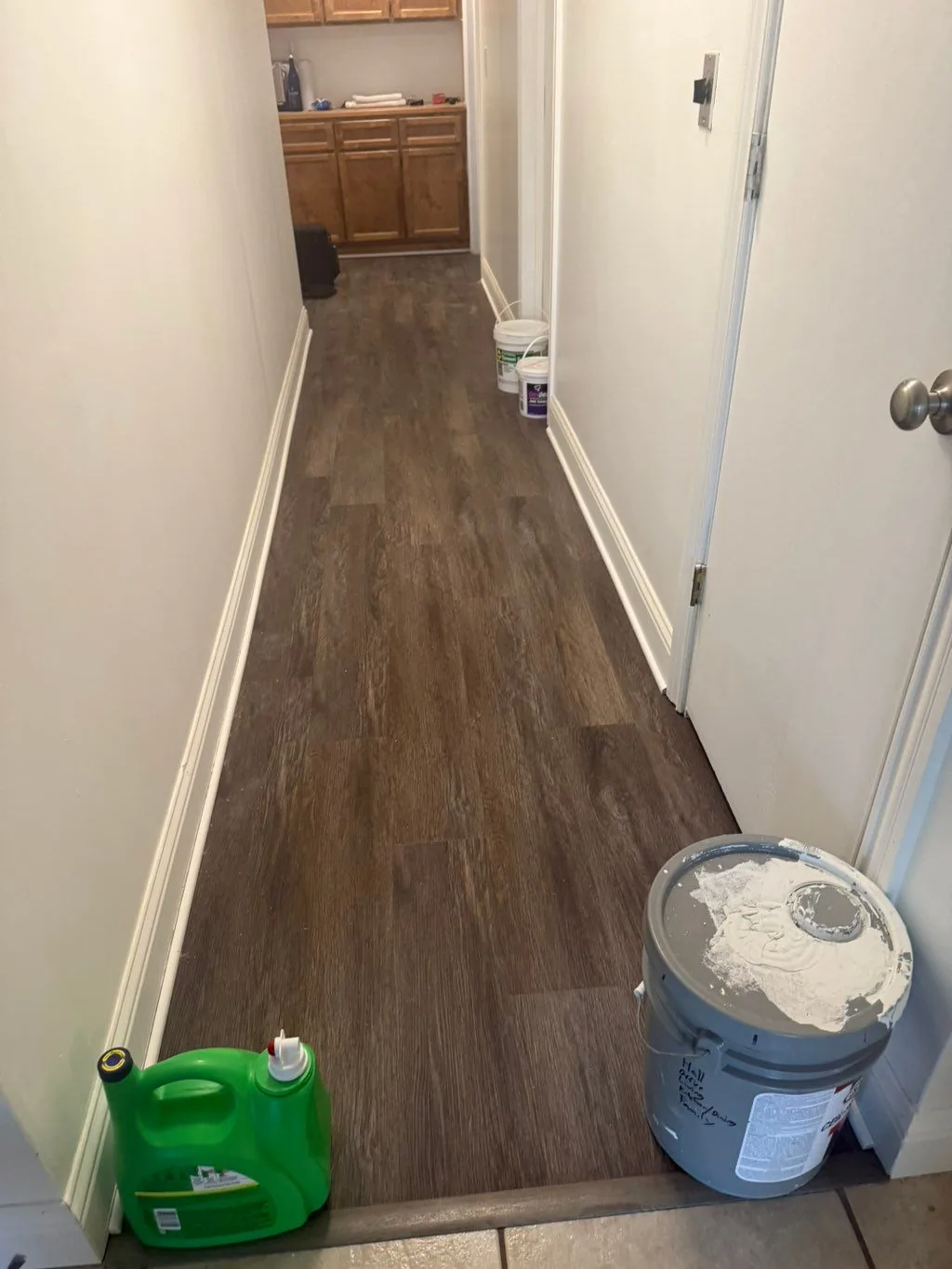
Homeowner Tips
Can You Install Vinyl Plank Over Existing Tile?
Often, yes, if the tile is sound, well bonded and flat enough. How to judge your tile, fill the grout lines, and know when tear-out is the better call.
Homeowner Tips · 10 min read
Published November 12, 2026 · Updated November 13, 2026
Yes, luxury vinyl plank can often go directly over an existing tile floor, and when the conditions are right it is one of the more sensible shortcuts in flooring. Tile is hard, stable, and usually flat, and leaving it in place skips a loud, dusty demolition. But the answer depends on three things the showroom cannot see: whether the tile is still bonded, whether its surface is flat enough for the plank you chose, and whether the house can absorb the extra height. This guide walks through each one, the prep that makes an overlay work, and the situations where we tell homeowners to tear the tile out instead.
If you are still choosing the plank itself, our guide to choosing luxury vinyl plank covers wear layers and cores; this article is only about what goes underneath it.
When Going Over Tile Works
An overlay works when the tile is doing the job of a good subfloor: it is solid, it does not move, and its surface is flat. The Resilient Floor Covering Institute's guidance for installing over an existing floor makes one point that governs everything else: follow the installation instructions published by the manufacturer of the new floor, because those instructions tell you what must be done to the existing surface first. ASTM F710, the industry practice for preparing concrete to receive resilient flooring, says the same thing in its own scope: it does not supersede the flooring or adhesive manufacturer's written instructions.
In practice that means three checks before anyone opens a box. The tile must be well bonded, with no hollow, loose, or rocking pieces. The surface must be flat within the tolerance the plank maker publishes, measured with a straightedge across the room, not judged by eye. And the finished height of tile plus new plank must work at every doorway, appliance, and stair. If all three pass, going over tile is a legitimate installation, not a shortcut.
Hollow, Loose, or Cracked Tile Comes First
Tap a tile floor with a coin or a screwdriver handle and listen. A solid tile sounds dull; a debonded one sounds hollow. The Tile Council of North America (TCNA) is measured about what that sound means. Its FAQ notes that a floor can sound hollow even when tile is bonded, and that hollow spots do not necessarily mean failure is imminent — over a concrete slab with no deflection, grout and gravity help keep it in place. Over wood framing, TCNA says, failure is more likely, because subfloor movement can break grout away from the tile and compound the instability.
For a new floor on top, the standard is stricter than "not failing yet." A loose tile under a floating floor can rock and click underfoot, and its broken grout can shift. Under a glue-down floor, the new adhesive bond is only as good as the tile it is stuck to. TCNA also notes that injecting epoxy under hollow tile may work in a small area but is not practical over a large one, and that any repair that does not address the cause of the failure may not last. Our approach: remove loose and hollow tiles, fill the void flush with a cement-based patch, and if the hollow area is widespread, treat it as a floor that needs to come out. Our hollow spots page describes the same diagnosis for other floor types.
Cracks deserve a second look. TCNA explains that whenever tile is bonded to concrete, movement in the concrete causes cracks in the tile layer, and that shrinkage cracks in a slab can stay dimensionally active. A cracked tile over a slab is often a slab crack showing through. Covering it with vinyl does not stop the slab from moving; the question is whether the crack has opened a height difference the new floor will feel. Our tile cracks page covers how to read them.
Grout Lines and Telegraphing
Grout joints are the most common reason an overlay looks wrong. RFCI defines telegraphing as resilient flooring conforming to the surface beneath so that imperfections become visibly distinguishable on the finished surface. A recessed grout joint is exactly that kind of imperfection, and on a thin, flexible glue-down plank, a grid of faint lines can appear across the room, most visibly in low, raking light from a window.
The fix is to make the tile surface monolithic. RFCI lists filling the embossing of an existing resilient floor with embossing leveler as one of its accepted alternatives to removal, and the same principle applies to tile: the grout joints are filled flush, and on rougher or textured tile a thin skim coat is troweled over the whole surface. ASTM F710 describes the material class — irregularities filled or smoothed with latex patching or a recommended underlayment compound. Which product, and whether the plank maker accepts a skim coat over glazed tile at all, is a question for the plank maker's instructions. Glossy glazed tile may need cleaning or abrading so the patch bonds, and TCNA cautions that mechanical or chemical abrasion of tile can release fine particles that are harmful if inhaled, so dust control is part of the job.
Wide joints, deep joints, and hand-made tile with crowned surfaces all make telegraphing more likely. Narrow joints in flat porcelain are the easiest case.
Uneven Tile and Lippage
Lippage is TCNA's term for differences in elevation between the edges of adjacent tiles, and TCNA notes that variations in the plane of the substrate also affect it. A tile floor can be perfectly bonded and still have edges that step up and down, especially large-format tile set over an uneven slab.
Rigid-core plank handles this better than flexible vinyl, but only within limits. ASTM F3261, the specification for rigid-core resilient flooring, says these products may use an attached underlay for reducing issues concerning minor subfloor irregularities. Minor is the operative word. A lipped tile edge under a click joint concentrates load on that joint, and repeated flexing there is a common path to the gaps described on our vinyl plank separating page. High edges are ground down and low areas filled until the floor meets the maker's flatness tolerance. When most of the floor needs that treatment, removal starts to look like the cheaper option.
Floor Height: Doors, Dishwasher, Appliances, Stairs
Going over tile raises the floor by the full thickness of the new plank, plus any underlayment and skim coat. TCNA's own rule for tiling over tile begins with the same condition: it is done regularly where there is not a floor height limitation. Walk the house with that in mind.
Doors. Interior doors usually need to be undercut, and an exterior door threshold may end up lower than the new floor. Doorways into rooms that are not being redone need a transition, and every reducer is a small step at the edge of the floor.
Dishwasher and appliances. A dishwasher installed on tile before the cabinets were set can become trapped once a new floor goes in around it, because the opening under the countertop does not get taller. Check the clearance before deciding, and confirm that the refrigerator still fits under any upper cabinet or panel. Range and refrigerator moves are covered in our preparation guide.
Stairs. Where the new floor meets a stair, the existing nosing or top tread no longer sits at the right height and is usually replaced with a matching stair nose. Adding height at the top or bottom of a flight also changes the first or last riser relative to the others, and uneven risers are a trip hazard. That is often where an overlay becomes a stair tread conversation.
Transitions. Where vinyl over tile meets carpet or wood that stays, the height difference decides which transition piece works and how visible it is.
Floating vs. Glue-Down Over Tile
Most overlays over tile are floating rigid-core plank, and for good reason. A floating floor is not bonded to the tile, so it bridges small imperfections rather than mirroring them, and the attached underlay ASTM F3261 describes helps with minor irregularities. It is also the most forgiving method if the tile has a coating or glaze that adhesives dislike. The tradeoff is that floating floors need expansion space at walls and fixed cabinets and must be allowed to move, which is why they are not pinned under heavy islands; our vinyl plank buckling page explains what happens when that space is missing.
Glue-down plank is thinner, which helps with height, and it suits rooms with rolling loads or long continuous runs. But because it conforms to the surface, it is the method most likely to telegraph grout lines, so the skim coat is not optional, and the adhesive maker has to approve bonding to the prepared tile surface. Our nail-down vs. glue-down vs. floating comparison covers the methods in more depth.
Moisture Over a Slab
In much of Greater Sacramento, ground-floor tile sits on a concrete slab, and existing tile does not answer the moisture question. RFCI's moisture guidance says manufacturer instructions typically require all concrete substrates, both new and existing, to be tested for moisture, and that results indicate only the condition of the area tested at the time of the test. The common methods are the calcium chloride test under ASTM F1869 and in-situ relative humidity probes under ASTM F2170, which RFCI describes as placed in holes drilled to about 40% of the slab's thickness. With tile covering the slab, how and where to test is a decision for the installer and the flooring maker's instructions.
RFCI adds two points that matter for an overlay. LVT and LVP are typically more moisture-tolerant than sheet vinyl because they are modular, and some manufacturers allow a one-part moisture membrane or a polyfilm underlayment under certain floating products, depending on the measured emission rate. Moisture limits also differ by installation method — full spread versus floating — so the same slab can be acceptable for one approach and not the other. If there are signs of trouble already, such as darkened grout that never dries or a musty smell, see our moisture under flooring page before covering anything. RFCI's own work practices say that where there is a strong musty odor, the source should be found and corrected before flooring work proceeds.
When to Tear Out Instead
Tear-out is the better call in a handful of situations.
Tile already over tile. RFCI's guidance for going over an existing resilient floor specifies a single flooring layer only. A floor that is already two layers of tile, or tile over old vinyl, has used up its height and has more layers whose bond you cannot inspect.
Uneven or lipped tile across most of the room. If grinding and patching would touch most of the floor, removal produces a flatter result for similar effort.
Widespread hollow tile, especially over wood framing. TCNA's distinction between slab and wood applies directly: loose tile over a framed floor points to movement that will keep working on whatever goes on top.
Bathrooms with toilets. Adding plank over bathroom tile changes the finished floor height relative to the toilet flange, which is set to suit the original floor. A flange left too low compromises the seal at the toilet, and that seal is the one place in a bathroom where water reaching the subfloor is routine if it fails. Combined with a short run of floor, a vanity toe kick, and a tub or shower curb, small bathrooms often come out better with tile removed. Our LVP vs. tile comparison covers whether to replace the tile with tile.
A Note on Asbestos Under Old Tile
In older homes, tile is sometimes set over an earlier resilient floor. The EPA lists vinyl floor tiles and the backing on vinyl sheet flooring and adhesives among the places asbestos may be found, and RFCI's work practices note that some asphaltic cutback adhesives and the backings of many older sheet vinyl floors contained it. RFCI says that unless you are positively certain a product is asbestos-free, you must presume it contains asbestos, and the EPA notes that you cannot tell by looking.
This changes the calculation. Tearing out tile bonded to an old resilient layer disturbs that layer. The EPA's homeowner guidance says not to sand or try to level asbestos flooring or its backing, and that when asbestos flooring needs replacing, installing new floor covering over it is preferred where possible. If the layers under your tile are unknown and you are leaning toward tear-out, have the material sampled by a trained and accredited asbestos professional first — the EPA does not recommend taking samples yourself.
Planning the Job
As a planning range, luxury vinyl plank runs roughly $5–10 per sq ft installed, and our cost calculator shows the bands side by side. Going over tile changes the scope, not the plank: grout filling, skim coating, tile repair, transitions, door undercuts, and stair noses replace demolition and haul-away. A quote that leaves out the prep is not comparable to one that includes it. Our luxury vinyl plank page covers the products we install.
Renaissance Floors is a licensed C-15 flooring contractor (CSLB #1060673) based in Roseville, serving Greater Sacramento and Northern California. If you are weighing an overlay against tear-out, contact us or call (916) 749-0272. We will check the tile for hollow spots, measure flatness and finished height at the doors, dishwasher, and stairs, and tell you which way the floor wants to go. Learn more about our floor installation service.
This article is part of our guide to how to choose a floor, which covers the order the decisions actually come in, and which constraints are real rather than preference.
Sources
- TCNA — FAQ: Hollow and Loose Tile
- TCNA — FAQ: Can I Tile Over Existing Ceramic Tile?
- TCNA — FAQ: Lippage (height variation between adjoining tiles)
- TCNA — FAQ: Cracked Tile Over Concrete (reflective cracking)
- RFCI — Recommended Work Practices for Removal of Resilient Floor Coverings (2018, PDF)
- RFCI — Moisture Mitigation: Installation Considerations for Resilient Floor Covering (PDF)
- RFCI — Resilient Flooring & Castor Wheel Assemblies (definition of telegraphing, PDF)
- ASTM F3261 — Resilient Flooring in Modular Format with Rigid Polymeric Core (scope)
- ASTM F710 — Preparing Concrete Floors to Receive Resilient Flooring (scope)
- ASTM F2170 — Relative Humidity in Concrete Floor Slabs Using in situ Probes (scope)
- U.S. EPA — Learn About Asbestos (where asbestos may be found)
- U.S. EPA — Protect Your Family from Exposures to Asbestos
Explore related
Good to Know
Frequently Asked Questions
Can you put luxury vinyl plank over ceramic or porcelain tile?
Often, yes. Luxury vinyl plank can go over ceramic or porcelain tile when the tile is well bonded with no hollow or loose pieces, the surface is flat within the plank manufacturer's tolerance, and the added height works at doors, appliances, and stairs. The plank maker's installation instructions decide what preparation the tile needs first.
Do you need to fill grout lines before installing vinyl plank over tile?
Usually, yes. Recessed grout joints can telegraph through vinyl plank as faint lines in the finished floor, especially with thin glue-down products and in low, raking light. Installers fill the joints flush with a cement-based patching compound, or skim coat the entire tile surface, using a product the vinyl manufacturer accepts.
Is floating or glue-down vinyl better over existing tile?
Floating rigid-core plank is usually the better choice over tile. It is not bonded to the tile, so it bridges minor irregularities, helped by its attached underlay. Glue-down plank is thinner, which helps with door and appliance clearances, but it conforms to the surface below, so the tile must be skim coated and the adhesive approved for it.
What if some of my tiles sound hollow?
Hollow-sounding tiles have lost some or all of their bond. TCNA notes this is more serious over wood framing than over a concrete slab. Before vinyl goes over tile, loose and hollow tiles should be removed and the voids filled flush with patching compound. If hollow areas are widespread, removing the tile is usually the better decision.
How much height does vinyl plank over tile add?
It adds the full thickness of the new plank, plus any underlayment and skim coat, on top of the tile already there. That raised floor can require undercutting interior doors, new transitions at adjoining rooms, replacement stair nosings, and a clearance check for a dishwasher installed before the cabinets, which can become trapped under the countertop.
Should I put vinyl plank over tile in a bathroom?
In many bathrooms, removing the tile is the better choice. Adding plank over tile raises the floor relative to the toilet flange, which was set for the original floor, and a flange that ends up too low can compromise the toilet seal. Small bathrooms also have tub curbs and vanity toe kicks, where added height is hard to hide.
Does vinyl plank over tile on a concrete slab need moisture testing?
Usually, yes. RFCI says resilient flooring manufacturers typically require all concrete substrates, new and existing, to be tested for moisture, using methods such as ASTM F1869 calcium chloride or ASTM F2170 in-situ relative humidity probes. Moisture limits differ between floating and glue-down installations, so the plank maker's instructions decide what is acceptable.
Can you install vinyl plank over two layers of tile or tile over old vinyl?
We generally advise against it. RFCI's guidance for going over an existing floor specifies a single flooring layer only, and each extra layer adds height and another bond that cannot be inspected. If old vinyl may be under the tile, the EPA advises having it sampled by an accredited asbestos professional before any tear-out disturbs it.
Is tearing out old tile risky if there is old vinyl underneath?
It can be. The EPA lists vinyl floor tiles, sheet vinyl backing, and adhesives among materials that may contain asbestos, and you cannot tell by looking. The EPA advises against sanding or leveling such flooring, recommends covering it where possible, and recommends sampling by a trained, accredited professional rather than taking samples yourself.
Where to go from here
If you are weighing options, the next read is LVP vs. tile. When it is about your own floor, see tile flooring or skip ahead: a free in-home estimate means Alex measures the rooms, checks the subfloor, and quotes the exact product — no planning ranges.
Local pages for tile flooring: Auburn, Folsom, Roseville, Santa Rosa, Sacramento, Oakland, San Rafael and San Jose.
Written by
Owner & Lead Installer, Renaissance Floors
15+ years of hands-on flooring experience across Greater Sacramento & Northern California. Works on hardwood and engineered installation, refinishing, subfloor preparation, and moisture testing — and writes these guides from what the jobs actually teach.
Licensed California contractor, CSLB C-15 license #1060673(verify ↗)


Related
Keep Reading
Related pages: Laminate vs. Solid Hardwood, Luxury Vinyl Plank vs. Laminate, American Walnut, and Wide-Plank Flooring.

Ready for Floors You'll Love?
Ready to talk through your project? Free estimates throughout Greater Sacramento & Northern California.