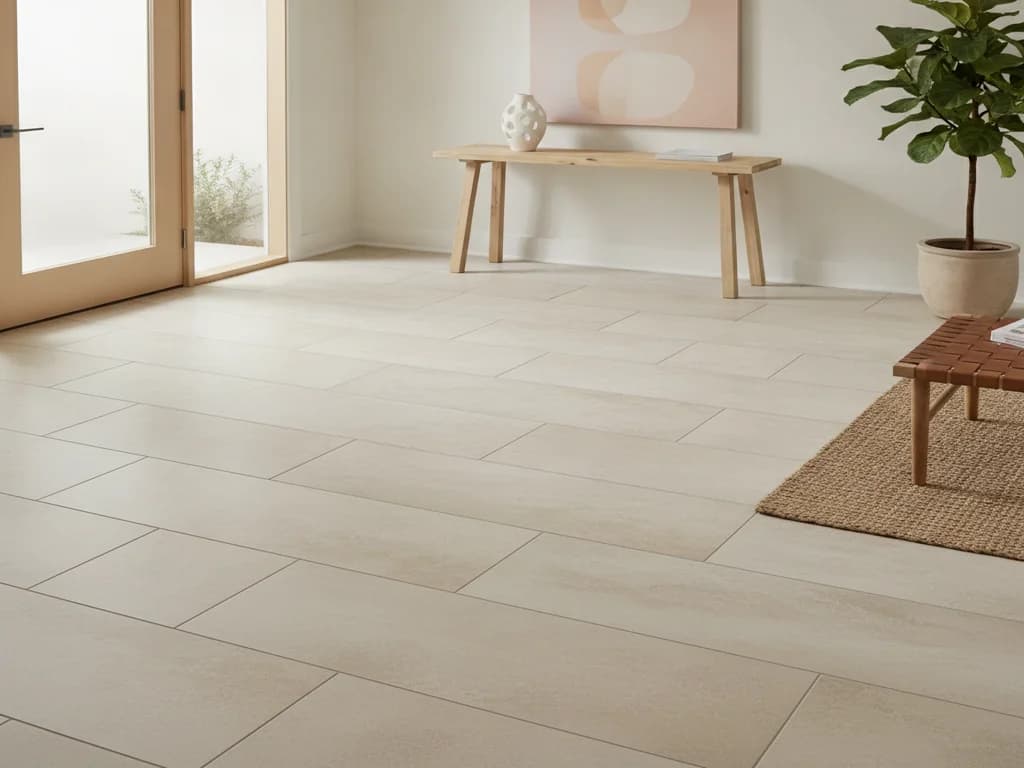
Comparison
Porcelain vs. Ceramic Tile
Porcelain or ceramic tile: what is the difference and which is better?
Porcelain or ceramic tile: what is the difference and which is better?
Choose porcelain for floors that take hard traffic, for outdoor areas, and anywhere water and freezing can work into the tile. Choose a glazed ceramic (non-porcelain) tile for walls, backsplashes and dry interior floors where its easier cutting and bonding are worth more than extra density. The difference is one measured number. The ANSI A137.1 ceramic tile standard defines porcelain as a tile with water absorption of 0.5% or less, tested by the ASTM C373 method. Anything that absorbs more than 0.5% is non-porcelain. Porcelain is still a ceramic tile: the Tile Council of North America (TCNA) lists it as one member of the "ceramic tile family." Both fall in the same planning band: about $10–20 per sq ft installed, as planning ranges.
You cannot tell porcelain from non-porcelain by looking at it. TCNA says the difference "cannot be detected by eye" and that only a laboratory water-absorption test settles it. That matters because TCNA also reports that tile not meeting the 0.5% limit is advertised and sold as porcelain, and that its lab has identified hundreds of series from international manufacturers that failed the porcelain criterion. The practical check is the Porcelain Tile Certification Agency (PTCA) mark, a program TCNA and the Ceramic Tile Distributors Association set up. A tile carrying it has been certified as true porcelain. The mark covers water absorption only. TCNA says it does not mean the tile met every other A137.1 requirement, and it does not make the tile fit for any particular use.
Low water absorption is not the same as a waterproof floor, and porcelain is not automatically the better choice. Grout joints are not waterproof, so in a shower or wet room the installation method and the layers under the tile protect the house, not the tile. TCNA notes that porcelain is usually frost resistant but not always, and that many non-porcelain tiles are rated for exteriors too. Porcelain is harder to cut and harder to bond. That makes little difference to you as long as the installer uses the right materials. Slip resistance is a separate rating. ANSI A326.3 asks for a wet DCOF of 0.42 or more on level interior floors expected to be walked on wet, and a polished porcelain is the standard's own example of a surface that may fall short.
Decision Framework
When Each One Wins
Conditions, not preferences. If one of these describes your project, it should carry more weight than anything else on this page.
Choose Porcelain tile when…
- Outdoor patios, steps and entries, including foothill homes where winter nights can freeze. TCNA says porcelain is usually frost resistant because of its low absorption, but confirm the product is rated by its maker for exterior use.
- Entries, kitchens and hallways that take grit and heavy traffic. TCNA describes unglazed porcelain as "quite durable (harder than granite)."
- Floors where a chip should not show a different color. Unglazed "through body" porcelain carries the same color all the way through, per TCNA.
- Wet floors where you want a textured, unglazed surface. TCNA notes that unglazed porcelains may have better slip resistance than glazed.
- Large, thin panels and slabs. Gauged porcelain has its own ANSI product standard (A137.3) and interior installation standard (A108.19).
- Buyers who want an independent check on what they are paying for. The PTCA certification mark exists only for porcelain.
Choose Ceramic tile when…
- Walls, backsplashes and shower walls, where nobody walks on the tile and density buys little. Wall tile is its own type within TCNA's ceramic tile family.
- Layouts with many cuts, such as around outlets, niches and window returns. TCNA says non-porcelain tile is usually easier to cut.
- Do-it-yourself projects. TCNA encourages DIY tiling and notes that non-porcelain tile is generally easier to bond to the floor.
- Dry interior floors such as a bedroom, office or formal living room, as long as the glaze has been tested and its hardness suits the traffic.
- Glazed surfaces that are easy to keep clean. Most non-porcelain tile is glazed, and TCNA says the glaze layer can be extremely durable.
- Exterior areas where a specific non-porcelain product is rated for that use. TCNA lists quarry tile among non-porcelain tiles rated for exteriors.
Side by Side
The Properties That Actually Differ
Where a figure is set by an individual product's instructions rather than by the material itself, the property is described as a relationship. An invented number would be worse than no number.
| Property | Porcelain tile | Ceramic tile |
|---|---|---|
| Definition (ANSI A137.1) | Water absorption of 0.5% or less, measured by ASTM C373. TCNA's wording: "an impervious tile." | Water absorption greater than 0.5%. A broad group: TCNA says non-porcelain tiles "cover a wide range of properties." |
| Same family? | Yes. Porcelain is one type within the A137.1 "ceramic tile family." | Yes. The family also includes pressed floor tile, quarry tile, wall tile, mosaic tile and specialty tile (TCNA). |
| How water absorption is measured | ASTM C373 vacuum method: samples are held under a strong vacuum while water is drawn into the pores, and absorption is the water weight gained as a percentage of dry weight (TCNA). | Same ASTM C373 test. The result places the tile above or below the 0.5% line. |
| Independent certification | Porcelain Tile Certification Agency (PTCA) mark, set up by TCNA and the Ceramic Tile Distributors Association. It certifies the 0.5% water-absorption criterion only. | No equivalent certification mark. Read the manufacturer's spec sheet for the tested properties. |
| How it is made | Porcelain-grade clays, precision milling, and kilns at about 2100°F to 2500°F, per TCNA's PTCA bulletin. | Fired above red heat like all ceramic tile (A137.1 definition), with properties that vary widely by type. |
| Glazed or unglazed | Both. Unglazed "through body" porcelain has the surface color all the way through. Glazed porcelain's glaze color may differ from the body. | Typically glazed. Unglazed quarry tile is the exception TCNA names. |
| Surface wear | Unglazed porcelain tends not to show wear "even in extreme applications" (TCNA). Many glazed porcelains are also very durable. | Depends on the glaze. TCNA: check that the tile has been tested and that the glaze hardness suits the application. |
| Abrasion test for glazed tile | ASTM C1027 (visible abrasion resistance of glazed ceramic tile) applies to glazed porcelain. It compares only tiles of like color and finish. | Same ASTM C1027 test for glazed ceramic. Ask for the result for a floor tile. |
| Breaking strength | ASTM C648 measures the force needed to break the tile. Its scope names porcelain tile. | Same ASTM C648 test, which also covers ceramic, mosaic, quarry and paver tile. |
| Freeze and thaw | Usually frost resistant because of low absorption, "although, not always" (TCNA). ASTM C1026 is the freeze-thaw test. | Many non-porcelain tiles can be used where freezing happens. Check the maker's "area of use" for exterior rating. |
| Slip resistance (ANSI A326.3) | Wet DCOF of 0.42 or more for level interior floors walked on wet. Unglazed porcelain may have better slip resistance; polished surfaces are the standard's example of ones that may test lower. | Same 0.42 wet DCOF rule. Check the product's declared use category (such as Interior, Wet) before using it on a bathroom or kitchen floor. |
| Cleaning | Glazed porcelain is usually a little easier to clean than unglazed, which can have microscopic holes (TCNA). | Glazed surfaces clean easily. Grout joints need the same care on either tile. |
| Cutting and bonding | Harder to cut and harder to bond (TCNA). The installer's choice of mortar and method matters more. | Generally easier to bond and usually easier to cut (TCNA). |
| Setting mortars | Polymer-modified thinset, with minimum performance set by ANSI A118.4 and A118.15. TCNA says the polymers can improve adhesion. Gauged porcelain panels: A108.19. | Dry-set thinset (ANSI A118.1) or polymer-modified (A118.4, A118.15), as the tile and substrate call for. |
| Install standards and the subfloor | ANSI A108 series and the TCNA Handbook methods. On a slab, cracks in the concrete reflect through bonded tile; a crack isolation membrane or mortar bed prevents it (TCNA). | Same. Over a wood subfloor, TCNA cites L/360 as the traditional minimum stiffness, while noting tile has failed on stiffer floors too. |
| Installed cost (planning range) | About $10–20 per sq ft installed, the same tile band. | About $10–20 per sq ft installed, the same tile band. |
It Depends
The Variables That Decide It
No comparison answers this for every house. These are the specific things about your project that move the answer, and they are worth establishing before you shop.
Whether the tile is really porcelain
The word on the box is not proof. TCNA says porcelain and non-porcelain cannot be told apart by eye, and that tile failing the 0.5% absorption limit is still sold as porcelain. In freeze-thaw and wet environments, TCNA warns, that mislabeling can lead to costly failures. Look for the PTCA certification mark. Know what it covers: TCNA describes PTCA testing as an assessment of the manufacturer, with samples tested once every three years for manufacturing participants. It checks water absorption, not dimensions, warpage or breaking strength, and it does not certify the tile for any particular use.
Where the tile goes
A wall, a dry bedroom floor, a kitchen, a shower floor and a patio ask different things of a tile. On a wall almost any well-made glazed tile works, and easier cutting helps. On a floor, check the maker's rating for floor use and, for glazed tile, the glaze's tested wear performance. Outdoors, TCNA says the tile must be rated by its maker for exterior use, the installation must drain, and the setting materials must suit exterior conditions. TCNA also calls for expansion joints outdoors to handle large temperature swings, which matters on a Sacramento Valley patio in summer as much as on a foothill step in winter.
Surface finish and slip
Porcelain versus ceramic says little about slip on its own. Finish and texture decide it. ANSI A326.3 sets 0.42 wet DCOF as the line for level interior floors expected to be walked on wet, and it names polished surfaces as an example of materials that may fall below it and should then stay dry. The standard also has manufacturer-declared use categories, from Interior, Dry to Exterior, Wet. Ask for the category. The standard notes that a floor's DCOF can change over time with wear and contaminants, so cleaning matters too.
What is under the floor
TCNA explains that tile bonded to a concrete slab will crack wherever the slab cracks and moves, and recommends a mortar bed over a cleavage membrane or a crack isolation membrane to stop it. That is common on slab-on-grade tract homes. In older raised-foundation homes over a crawlspace, the question is floor stiffness. TCNA cites L/360 as the traditional minimum, but notes tile has failed on stiffer floors and points to proven installation methods instead. Neither porcelain nor ceramic changes this. Choosing porcelain does not fix a moving subfloor.
Tile size and the installer
Porcelain's density makes it harder to cut and bond, and large tiles raise the stakes. TCNA advises sliding or rotating tiles 10 by 10 inches and larger to flatten the trowel ridges, or voids can leave the tile loose or cracked. Large tiles need more mortar, and a flat substrate is needed to keep edges level. TCNA's lippage guidance (ANSI A108.02) notes that the angle of light and highly reflective surfaces make height differences between tiles more noticeable. For large-format porcelain, ask the installer which mortar they will use, whether it meets A118.4 or A118.15, and how they will check coverage.
How the floor will be used and kept
Grit tracked in from outside is what wears a glazed surface, and unglazed through-body porcelain hides that wear best because the color runs through the tile. Glazed tile of either kind is usually easier to wipe clean. TCNA says glazed porcelain is usually a little easier to clean than unglazed. A busy family entry, a dog's water bowl or a mudroom points toward porcelain with a textured or unglazed face. A guest bath or a wall points toward whichever tile you like the look of.
On this site: Tile Flooring, Natural Stone Flooring, Tile vs. Luxury Vinyl for Bathrooms, Best Flooring for Kitchens, Tile Cracks, Tile Tenting, Hollow Spots, Subfloor Movement, Caring for Tile, and Flooring Cost Calculator.
Next decision: Hardwood vs. Tile, LVP vs. Tile, and Epoxy vs. Polyaspartic.
See all 22 flooring comparisons, or look up a term in the glossary.
Common Questions
Frequently Asked Questions
Is porcelain tile better than ceramic tile?
For hard-traffic floors and outdoor areas, porcelain is usually the safer choice. For walls and dry interior floors, a good glazed ceramic is a legitimate pick. The defining difference, per ANSI A137.1, is water absorption: 0.5% or less for porcelain by the ASTM C373 test, more than 0.5% for non-porcelain. Both fall in the same planning band of about $10–20 per sq ft installed.
Is porcelain a type of ceramic tile?
Yes. TCNA describes a "ceramic tile family" defined by the ANSI A137.1 standard, and porcelain is one member of it, alongside pressed floor tile, quarry tile, wall tile, mosaic tile and others. When people say "ceramic" in a store, they usually mean non-porcelain tile.
How can I tell if a tile is really porcelain?
Look for the Porcelain Tile Certification Agency (PTCA) mark on the box or spec sheet. TCNA says you cannot tell porcelain from non-porcelain by eye, and only a lab test of water absorption is certain. PTCA certification confirms the 0.5% limit. It does not confirm the tile's other properties or that it suits your room.
Is porcelain tile waterproof?
The tile itself absorbs very little water, but a tile floor is not waterproof. TCNA points out that grout joints are not waterproof, so in a shower or other wet area the installation method and the substrate are what keep water out of the house. A bonded waterproof membrane under the tile (ANSI A118.10 is its specification) does that job, whichever tile goes on top.
Can ceramic tile go outside?
Some can. TCNA says porcelain is not the only tile rated for exteriors and that many non-porcelain tiles, such as quarry tile, are rated for outdoor use. Check the maker's "area of use" for the specific product. ASTM C1026 is the freeze-thaw test. TCNA adds that even frost-resistant tile can be damaged when water sits in grout joints or setting-bed voids and freezes, so slope and drainage matter as much as the tile. ANSI A326.3 also notes that an "Exterior, Wet" slip label does not refer to frost resistance.
Which is more slippery?
Neither, as a category. Slip resistance depends on finish and texture. ANSI A326.3 sets a wet DCOF of at least 0.42 for level interior floors expected to be walked on wet, and names polished surfaces as an example of ones that may fall below it. TCNA notes that unglazed porcelain may have better slip resistance than glazed. Ask for the product's DCOF value and declared use category.
Does porcelain cost more than ceramic?
TCNA's PTCA bulletin says real porcelain is typically more expensive than non-porcelain tile with the same decorative look, because of its raw materials, energy and equipment. Installed, both fall in the same planning band of about $10–20 per sq ft, because labor, substrate preparation and tile size drive much of the total. Use the cost calculator for your room.
Is porcelain harder to install?
Yes, somewhat. TCNA says porcelain is harder to cut and harder to bond than non-porcelain, but that this makes little difference to you as long as the installer uses the right materials. Polymer-modified thinset mortars meeting ANSI A118.4 or A118.15 are the common choice, and large tiles need full coverage, which means flattening the trowel ridges as each tile is set.
What does a wear or abrasion rating on a tile box mean?
For glazed tile, ASTM C1027 is the ASTM test for visible surface abrasion. It wears the surface with an abrasive load and compares the result with unabraded tile. It only compares tiles of like color and finish. C1027 is written for glazed tile, so it does not rate unglazed through-body porcelain. Ask the maker which rating the product carries and which areas it is rated for.
Can tile go over a crack in my concrete slab?
Not directly. TCNA explains that cracks in concrete reflect through tile bonded to it, and that even small shrinkage cracks can grow as the slab keeps curing. The fix is a crack isolation membrane under thinset tile, or a mortar bed over a cleavage membrane. TCNA also recommends carrying slab control joints up through the tile. This applies equally to porcelain and ceramic.
Sources
Where These Specifics Come From
Industry guidelines, manufacturer instructions, and regulations cited on this page.
- FAQ: Porcelain vs. Non-Porcelain — 0.5% absorption, frost resistance, glazed vs. unglazed, through-body, cutting and bonding, exterior ratingsTile Council of North America
- Porcelain Certification — PTCA program and the ASTM C373 0.5% definitionTile Council of North America
- Porcelain Tile Certification and the PTCA (TCNA Tile Initiative bulletin, PDF) — ceramic tile family, A137.1 and ISO 13006 definitions, firing temperatures, C373 vacuum method, scope of the markTile Council of North America
- ANSI A326.3-2021 — Dynamic Coefficient of Friction of Hard Surface Flooring (free copy) — §3.1/3.2 0.42 wet DCOF, use categoriesTile Council of North America
- ANSI Standards — A137.1, A137.3, A108 series (incl. A108.02, A108.19), A118.1, A118.4, A118.15Tile Council of North America
- TCNA Handbook for Ceramic, Glass, and Stone Tile Installation — scope and useTile Council of North America
- FAQ: Thinset / Dry-Set Mortar — A118.1, A118.4, A118.15Tile Council of North America
- FAQ: Installing Tile — grout not waterproof, setting tiles 10x10 in and larger, control jointsTile Council of North America
- FAQ: Frost Resistance and FAQ: Exteriors — C1026/C373, drainage, exterior ratingsTile Council of North America
- FAQ: Cracked Tile and FAQ: Deflection — reflective cracking, L/360Tile Council of North America
- C373 — Water Absorption and Associated Properties by Vacuum Method for Pressed Ceramic Tiles (scope)ASTM International
- C1026 — Resistance of Ceramic and Glass Tile to Freeze-Thaw Cycling (scope)ASTM International
- C648 — Breaking Strength of Ceramic Tile (scope)ASTM International
- C1027 — Visible Abrasion Resistance of Glazed Ceramic Tile (scope)ASTM International
Ready to price it for your house?
See how we install tile flooring, check tile installation cost, or skip ahead: a free in-home estimate means Alex measures the rooms, checks the subfloor, and quotes the exact product — no planning ranges.
Local pages for tile flooring: Auburn, Folsom, Roseville, Santa Rosa, Sacramento, Oakland, San Rafael and San Jose.
Comparison written by
Owner & Lead Installer, Renaissance Floors
15+ years of hands-on flooring experience across Greater Sacramento & Northern California. Works on hardwood and engineered installation, refinishing, subfloor preparation, and moisture testing — and writes these guides from what the jobs actually teach.
Licensed California contractor, CSLB C-15 license #1060673(verify ↗)
Get a Straight Answer for Your House
Free estimates across Greater Sacramento & Northern California. We'll look at your subfloor and your rooms and tell you which of these actually fits — call (916) 749-0272.