Comparison
Engineered Hardwood vs. Luxury Vinyl Plank
Engineered hardwood or luxury vinyl plank: which should you choose?
Engineered hardwood or luxury vinyl plank: which should you choose?
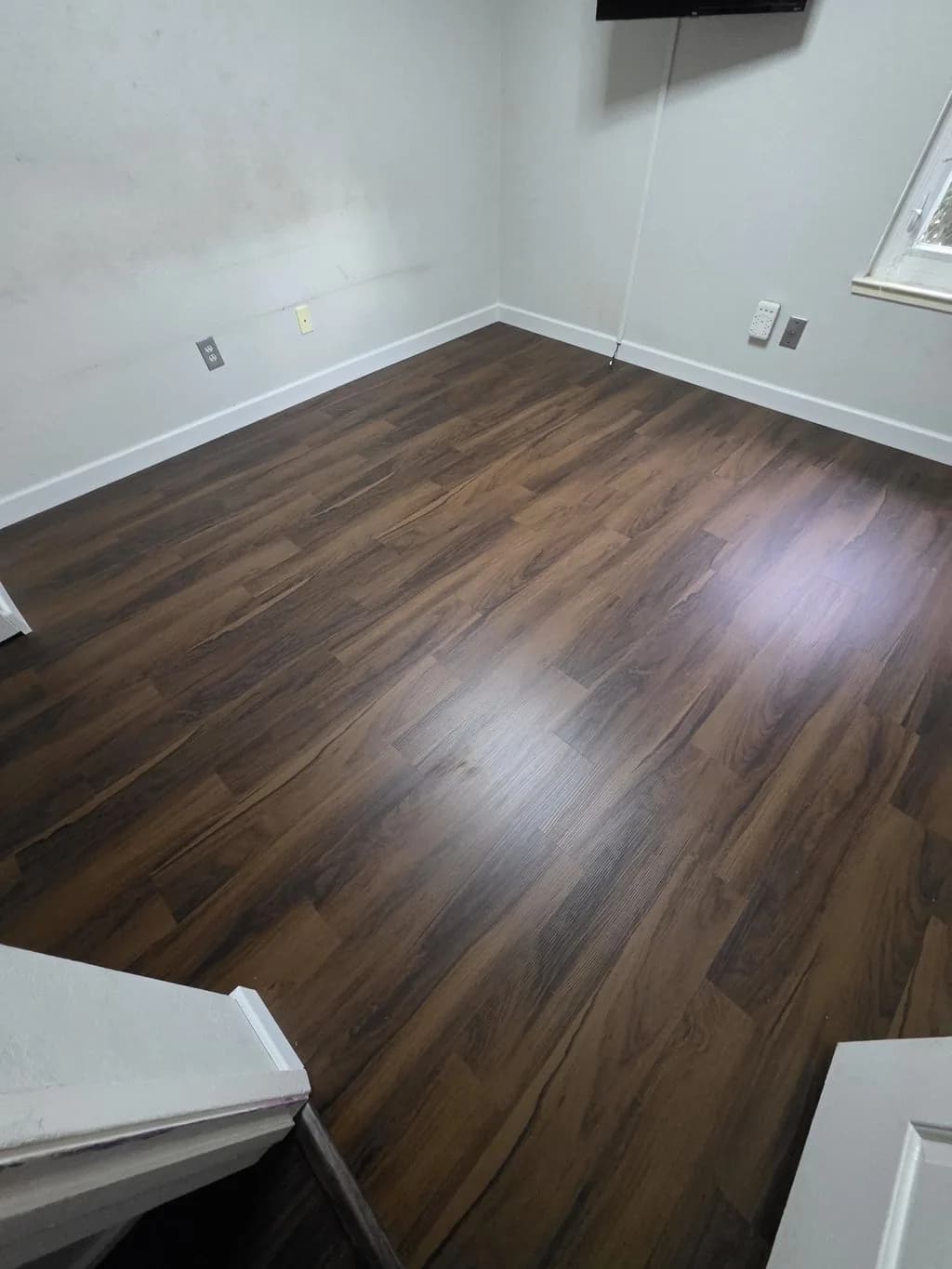
Choose luxury vinyl plank (LVP) for rooms that can get wet and for rentals or busy households that need a floor you replace plank by plank. Choose engineered wood for living areas, bedrooms and halls where you want real wood that can be renewed instead of replaced. The surface is the whole difference. The engineered wood standard, ANSI/HPVA EF 2020, defines a board of bonded plies whose decorative face is a wood veneer. LVP's standards, ASTM F1700 and F3261, describe a printed or surface-decorated layer protected by a clear wear layer over a vinyl or rigid polymer core. Wood can be sanded and refinished. A printed layer cannot. Planning ranges run about $8–15 per sq ft installed for engineered wood and about $5–10 for LVP.
Water is where the two split hardest. The EF 2020 standard warns that plumbing leaks, rain through open windows or doors and "excessively wet concrete slabs" can cause engineered wood to warp, delaminate, check and lose its finish. The NWFA tells owners to clean spills right away with a dry or slightly damp cloth and never to use wet mops or steam mops on a wood floor. LVP has no wood in the plank to swell, so spills and damp mopping do not hurt it. Its seams are not seals, though. Water that gets through them reaches the subfloor under either floor.
Renewal is where engineered wood wins. The NWFA says engineered floors can be sanded and refinished, though not as many times as solid wood, and that the number of sandings depends on the wear-layer thickness, the contractor, the equipment and the floor's flatness. EF 2020 sets no minimum: veneer thickness "will vary according to the design and intended use as specified by the manufacturer." So read the wear layer on the spec sheet before you count on a future refinish. LVP is rated by the thickness of its clear wear layer, measured by ASTM F410, and when that layer wears through, the plank is replaced.
Decision Framework
When Each One Wins
Conditions, not preferences. If one of these describes your project, it should carry more weight than anything else on this page.
Choose Engineered wood when…
- Living rooms, dining rooms, bedrooms and halls where you want real wood. The face of every board is a wood veneer under EF 2020's definition.
- You plan to keep the floor a long time. A thick wear layer can be sanded and refinished, and the NWFA describes a lighter maintenance coat (clean, lightly sand, fresh finish) for a floor that has only dulled.
- You want to change the color later. The NWFA notes that sanding back to raw wood is the chance to change a floor's color. LVP's color is printed in.
- Slab-on-grade rooms where wood is wanted. Its cross-ply build is why EF 2020 says dimensional changes are "minimized," and why the NWFA calls engineered ideal for basements, subject to a slab moisture test and the maker's instructions.
- You want a third-party formaldehyde check on the core. EF 2020 holds engineered wood to the CARB and TSCA Title VI hardwood plywood limit of 0.05 ppm and requires a TSCA Title VI label on every package.
- A house you can keep near the NWFA's comfort band of 60–80°F and 30–50% relative humidity year-round.
Choose Luxury vinyl plank when…
- Bathrooms, laundry rooms and mudrooms, where water sits on the floor. There is no wood in the plank to swell or delaminate.
- Kitchens with a dishwasher, ice-maker line or sink where a slow leak can go unnoticed for hours.
- Concrete slabs whose moisture is uncertain. RFCI's moisture guide says LVT/LVP is "typically more moisture-tolerant" than sheet vinyl because it goes down as separate planks.
- Rentals and busy family rooms where a damaged plank should be swapped, not sanded.
- Pet accidents that may be found late. The plank does not swell, and the cleanup is a wipe, not a refinish.
- Tighter budgets. LVP's planning range is about $5–10 per sq ft installed against about $8–15 for engineered wood.
Side by Side
The Properties That Actually Differ
Where a figure is set by an individual product's instructions rather than by the material itself, the property is described as a relationship. An invented number would be worse than no number.
| Property | Engineered wood | Luxury vinyl plank |
|---|---|---|
| What it is (per the governing standard) | Layers or plies bonded with adhesive, grain of alternate plies generally at right angles, with a decorative face veneer of hardwood, softwood, cork or woody grass (ANSI/HPVA EF 2020). | A printed or surface-decorated layer protected by a clear wear layer: solid vinyl in flexible plank (ASTM F1700), or over a polymeric rigid core in rigid-core plank (ASTM F3261). |
| Core | Hardwood plywood is the most common. The DHA also lists HDF, MDF, particleboard and combi-core as cores. | Vinyl throughout (flexible) or a rigid polymer core, with an optional attached underlay. F3261 requires vinyl chloride polymers to make up at least 60% of the wear-surface binder by weight. |
| Surface you walk on | Real wood veneer. The species sets hardness: EF 2020 Table 1 lists face species in order of relative hardness and wearing capability, hickory first and pine last. | A clear wear layer over a printed image. Its thickness is measured in mils by ASTM F410. |
| Hardness ratings | The NWFA notes that Janka hardness values are for solid wood and "none of these values apply to engineered wood flooring." Compare species and finish instead. | No Janka or AC rating. Compare products by wear-layer thickness and, for rigid core, ASSURE certification. |
| Spills and wet mopping | Wipe spills immediately with a dry or slightly damp cloth. No wet mops or steam mops (NWFA). | Spills and damp mopping do not harm the plank itself. |
| Leaks and standing water | EF 2020: plumbing leaks, rain through open windows or doors and excessively wet slabs can cause warping, delamination, surface checks, discoloration and finish damage. | The plank does not swell, but the joints are not seals. Water that gets through reaches the subfloor and dries slowly under the floor. |
| Bathrooms and laundry rooms | We recommend against it in rooms with regular standing water, for the reasons EF 2020 lists. | Yes. This is what the category is chosen for. |
| Bond / build quality test | EF 2020 three-cycle soak: specimens soaked 4 hours in water at about 75°F, then oven-dried 19 hours at 120–125°F; 95% must pass the first cycle and 85% the third. | ASSURE-certified rigid core is tested to F3261 for composition, size tolerance, thickness and wear-layer thickness, plus at least 17 lbf in ASTM F3781 vertical edge-strength testing. |
| Humidity and moisture content | EF 2020: ships at 5–9% average moisture content. NWFA: keep the home at 30–50% relative humidity to limit cupping and gapping. | Not sensitive to indoor humidity the way wood is. Follow the maker's expansion-gap rules for temperature movement. |
| Over a concrete slab | Common, glue-down or floating, but EF 2020 tells you to check the maker's instructions for below-grade use. Test the slab first (ASTM F2170 in-slab RH, or ASTM F1869 calcium chloride). | Common. RFCI says every slab, of any age and grade level, should be tested, and some floating products allow a polyfilm underlayment instead of a membrane. |
| Refinishing | Yes, limited by wear-layer thickness. NWFA: fewer times than solid wood. EF 2020 sets no minimum veneer thickness. | None. A printed decor under a clear layer has nothing to sand. |
| Sun | Wood changes color under UV light, usually as an even mellowing, but shaded and sunny areas can differ (EF 2020 Appendix A4.3). | Shades and rugs help. Vinyl moves with temperature, so follow the maker's limits for rooms behind big glass. |
| Dents | EF 2020: no wood floor withstands very high point loads such as stiletto heels or narrow furniture feet. Use wide, non-scratching protectors. | Heavy, narrow feet can leave a permanent mark. Use wide floor protectors. |
| Indoor air quality check | CARB and TSCA Title VI hardwood plywood limit, 0.05 ppm, tested with only the face exposed (EF 2020 §4.5). | ASSURE requires CDPH Standard Method v1.2 VOC testing and caps ortho-phthalates at 1,000 ppm. |
| Repair | Sand and refinish, recoat, or replace individual boards. | Replace individual planks. Keep a box from the original run, because tones drift between print runs. |
| Installed cost (planning range) | About $8–15 per sq ft installed. | About $5–10 per sq ft installed. |
It Depends
The Variables That Decide It
No comparison answers this for every house. These are the specific things about your project that move the answer, and they are worth establishing before you shop.
Whether the room can get wet
This settles most of these decisions on its own. A bathroom, laundry room, mudroom or sink run has a real path to standing water, and that points to vinyl. EF 2020 lists plumbing leaks and rain through open doors and windows among the causes of warping and delamination in engineered wood. A bedroom, office or living room usually has no such path, and there engineered wood's real surface and refinish potential are worth paying for. Many homes end up with both: wood in the living spaces, vinyl in the wet rooms.
The wear-layer thickness on the spec sheet
Both floors live or die by a top layer, but the layers do different jobs. On engineered wood, the veneer is what you sand, and EF 2020 leaves its thickness to the maker, so two boards that look the same can have very different refinish potential. On LVP, the clear wear layer is what protects the print, and ASTM F410 is how it is measured. Ask for both numbers. A thin-veneer engineered board may only ever take a maintenance coat, which takes away its main advantage.
What is under the floor
Over concrete, test before choosing. RFCI says every concrete slab, of any age and grade level, should be tested for moisture, using ASTM F1869 (calcium chloride) or ASTM F2170 (in-slab RH probes, set at about 40% of the slab's depth), checked against the maker's limit. EF 2020 names excessively wet slabs as a cause of engineered wood damage and tells you to check the maker's instructions for below-grade use. Sacramento-area slab-on-grade tract homes are good candidates for either floor once the slab tests dry. In older raised-foundation homes, deal with a damp crawlspace first. Neither floor fixes it.
How steady your indoor humidity is
Engineered wood moves far less than solid wood, but it is still wood. The NWFA recommends 60–80°F and 30–50% relative humidity year-round. EF 2020's moisture table puts wood at about 6.2% moisture content at 70°F and 30% RH, and about 9.2% at 50% RH. A house that runs air conditioning all summer and heat all winter can drift below that band. A hygrometer tells you. If readings sit low for long stretches, expect seasonal gaps in wood. LVP does not care.
How long you will own the floor
Engineered wood's advantage plays out over many years: sanding, recoating, maybe a color change. If the floor will be torn out at the next remodel or a tenant turnover, you pay for that refinish potential and never use it. If you plan to stay, a thick-veneer engineered floor can be renewed in place when LVP would have to be replaced.
Pets, kids and what actually damages your floors
Claws and grit scratch both. On engineered wood, scratches in the finish can be recoated and deeper ones sanded out if the veneer allows. On LVP, a scratch through the wear layer means a new plank. Accidents are different. Urine left on wood can stain it and lift the finish, and vinyl does not absorb it. If accidents are likely, choose LVP. If scratches are the main worry, a harder species near the top of EF 2020's Table 1, such as hickory or hard maple, with a matte finish hides wear well.
On this site: Engineered Wood Flooring, Luxury Vinyl Plank, Journal: hardwood vs. luxury vinyl plank, How to Choose Luxury Vinyl Plank, Best Flooring for Dogs and Pets, Floor Refinishing, Engineered Wood Delamination, Moisture Under Flooring, Caring for Engineered Wood, Caring for Luxury Vinyl Plank, and Flooring Cost Calculator.
Next decision: Engineered vs. Solid Hardwood, LVP vs. Laminate, and Screen-and-Recoat vs. Full Refinish.
See all 22 flooring comparisons, or look up a term in the glossary.
Common Questions
Frequently Asked Questions
Is engineered hardwood better than luxury vinyl plank?
Not across the board. Engineered wood is better where you want real wood that can be sanded and refinished. LVP is better where water is likely, because there is no wood in the plank to swell. Planning ranges are about $8–15 per sq ft installed for engineered wood and about $5–10 for LVP. Decide room by room. Many homes use both.
Is engineered hardwood real wood?
Yes. ANSI/HPVA EF 2020 defines it as bonded plies with a decorative face veneer of real wood, and the Decorative Hardwoods Association calls it "real genuine wood." LVP is a printed image of wood under a clear wear layer.
Is engineered wood waterproof?
No. EF 2020 warns that leaks, rain through open windows or doors and excessively wet slabs can warp and delaminate it, and the NWFA says to wipe spills right away and never wet-mop or steam-mop a wood floor. Everyday spills cleaned up promptly are fine. For a bathroom or laundry room we recommend LVP.
Can engineered hardwood be refinished?
Usually, yes, but fewer times than solid wood, per the NWFA. How many times depends on the wear-layer thickness, the floor's flatness and condition, and the contractor's skill and equipment. EF 2020 lets the maker set veneer thickness, so check the spec sheet. A floor that has only dulled may need just a maintenance coat: clean, lightly sand, fresh finish.
Can luxury vinyl plank be refinished?
No. It is a printed decor under a clear wear layer, so there is no wood to sand. Worn or damaged planks are replaced. Keep a labeled box of planks from the original run for repairs.
Which is better over a concrete slab?
Both are common over slabs, after testing. RFCI says every slab should be tested for moisture regardless of age, using ASTM F1869 or F2170 against the maker's limit. LVP is the more forgiving choice where moisture is uncertain. Engineered wood is the wood floor built for slabs, but EF 2020 lists excessively wet slabs as a cause of warping and delamination.
Which is better with dogs?
LVP if accidents are likely, because it does not absorb urine or swell. Engineered wood if scratches are the main concern and you want to recoat or sand them out later. Choose a harder species and a lower-sheen finish. Either way, keep nails trimmed and put mats at the doors.
Does engineered hardwood have formaldehyde?
Its core is usually a composite wood panel such as hardwood plywood, so it is regulated. EF 2020 requires engineered wood flooring to meet the CARB and TSCA Title VI hardwood plywood limit of 0.05 ppm and to carry a TSCA Title VI compliance label on every package. For rigid-core LVP, RFCI's ASSURE certification requires CDPH Standard Method v1.2 VOC emissions testing.
Does engineered wood or LVP add more to resale?
We have no reliable resale figure for either, so we won't quote one. What we can say: engineered wood is real wood and can be refinished for a new owner, while LVP is easier to keep looking clean in a rental or a busy house. Choose for how you will use the rooms.
Sources
Where These Specifics Come From
Industry guidelines, manufacturer instructions, and regulations cited on this page.
- ANSI/HPVA EF 2020 — American National Standard for Engineered Wood Flooring: definition, veneer thickness, 5–9% moisture content, three-cycle soak bond test, 0.05 ppm formaldehyde, TSCA Title VI labeling, Table 1 species hardness order, Table 3 EMC, Appendix A moisture, light and indentation notesDecorative Hardwoods Association (HPVA)
- Engineered Hardwood Flooring — real wood, plywood and alternative coresDecorative Hardwoods Association (HPVA)
- Types of Wood Floors — engineered vs. solid, refinishing, basementsNational Wood Flooring Association
- Problem Prevention — cupping, gapping, 60–80°F and 30–50% humidityNational Wood Flooring Association
- Refinishing Your Floors — maintenance coat, resand, what limits sandingNational Wood Flooring Association
- Maintenance — spills, no wet or steam mops, recoatingNational Wood Flooring Association
- Durability — Janka scale does not apply to engineered wood flooringNational Wood Flooring Association
- Flooring Types — LVT and rigid core/multilayer definitionsResilient Floor Covering Institute
- ASSURE Certified — F3261 wear-layer testing, CDPH v1.2 emissions, ortho-phthalates, ASTM F3781 17 lbf edge strengthResilient Floor Covering Institute
- Moisture Mitigation: Installation Considerations for Resilient Floor Covering — test every slab, F1869, F2170 at 40% depth, LVT/LVP moisture toleranceResilient Floor Covering Institute
- F3261 — Resilient Flooring in Modular Format with Rigid Polymeric Core (scope and abstract)ASTM International
- F1700 — Solid Vinyl Floor in Modular Format (scope)ASTM International
- F410 — Wear Layer Thickness of Resilient Floor Coverings by Optical Measurement (scope)ASTM International
- F2170 — Relative Humidity in Concrete Floor Slabs Using in situ Probes (scope)ASTM International
Ready to price it for your house?
See how we install luxury vinyl plank, check LVP cost, or skip ahead: a free in-home estimate means Alex measures the rooms, checks the subfloor, and quotes the exact product — no planning ranges.
Local pages for luxury vinyl plank: Auburn, Folsom, Roseville, Santa Rosa, Sacramento, Oakland, San Rafael and San Jose.
Comparison written by
Owner & Lead Installer, Renaissance Floors
15+ years of hands-on flooring experience across Greater Sacramento & Northern California. Works on hardwood and engineered installation, refinishing, subfloor preparation, and moisture testing — and writes these guides from what the jobs actually teach.
Licensed California contractor, CSLB C-15 license #1060673(verify ↗)
Get a Straight Answer for Your House
Free estimates across Greater Sacramento & Northern California. We'll look at your subfloor and your rooms and tell you which of these actually fits — call (916) 749-0272.